
You don’t cry in public. You show up to work. You handle it. But inside, it’s getting harder to believe anything can actually help.
You’ve already tried talking to someone. Maybe even a few someones. You’ve journaled. You’ve read. You’ve survived this long. But it feels like your thoughts keep pulling you under—and no matter what you try, they always seem to win.
If you’re mentally exhausted and hesitant to believe that therapy could still help, you’re not alone. At Scioto Wellness Center in Hilliard, Ohio, we’ve walked alongside many people who felt the same way. And many of them found real relief—not just hope, but change—through cognitive behavioral therapy, or CBT.
What Is CBT Therapy—and Why Does It Work?
CBT stands for cognitive behavioral therapy. It’s one of the most widely studied and effective forms of therapy for anxiety, depression, and other mental health challenges. But what makes it different—and often more effective for people feeling overwhelmed—is its focus on the here and now.
Rather than digging endlessly into your past, CBT looks at how your current thoughts, beliefs, and behaviors might be reinforcing pain. It teaches you how to notice unhelpful patterns and offers tools to challenge and reshape them.
You might think of it like learning a new language—a way to talk to yourself that’s less harsh, more grounded, and more accurate. For people used to drowning in self-criticism or anxiety spirals, CBT can feel like learning how to breathe again.
You’re Not Broken—Your Brain Just Got Stuck
One of the first truths CBT teaches is this: your brain is doing exactly what it was designed to do. It’s just overcorrecting.
Our brains are wired to keep us safe. But when we’ve experienced prolonged stress, trauma, or mental health symptoms, that safety system can get overactive. You start expecting the worst without realizing it. You rehearse failure before you even try. You brace for impact—even when there’s no crash coming.
CBT doesn’t shame those instincts. It helps you slow down and see them for what they are: protective habits that no longer serve you. From there, you can learn to build new habits—ones rooted in reality, not fear.
You Deserve More Than Just Coping
A lot of therapy can feel like a space to vent. And while that can be helpful, it doesn’t always move the needle. CBT gives you something more than emotional support—it offers structure, strategy, and skill-building.
Here’s how one client put it:
“It felt like every other therapist just listened. My CBT therapist actually showed me how to change the way I think. I finally felt like I wasn’t just surviving—I was getting stronger.”
— Outpatient Client, 2023
CBT sessions often involve exercises, thought-tracking, and between-session experiments. These aren’t homework in the traditional sense—they’re opportunities to practice new thinking patterns in real life. Over time, the changes become automatic. And that’s when things really start to shift.
When You’ve Tried Everything Else
It’s not unusual to find CBT after everything else has felt like a dead end.
Maybe you’ve bounced between providers. Maybe you’ve tried mindfulness, EMDR, medication—or nothing at all. The point is: you’ve been trying. You’ve been fighting this for longer than most people know.
CBT can offer something refreshing to people in that place. It doesn’t promise to “fix” you. It doesn’t ask you to believe in magic. It gives you tools to use right now—tools that work even when motivation is low and hope is thin.
That’s why CBT is often recommended as a front-line treatment for depression, anxiety, OCD, and PTSD. It’s structured, trackable, and proven. It doesn’t rely on feeling good to start working—it helps you work toward feeling better.
What CBT Looks Like at Scioto Wellness Center
At Scioto Wellness Center, our CBT therapy is tailored to your pace. Some clients come in unsure, with walls up and energy down. That’s okay. Our job is to meet you where you are and move forward gently.
In sessions, you’ll work with a licensed therapist to:
- Identify thought patterns that cause distress or keep you stuck
- Learn how those thoughts influence feelings and behaviors
- Practice reframing unhelpful thoughts into more accurate ones
- Build new coping strategies for difficult emotions or situations
You won’t be pressured to share things you’re not ready to. And you won’t be given a workbook and left on your own. This is a collaborative, human-first process—backed by science, powered by empathy.
We provide CBT therapy right here in Hilliard, Ohio, both in-person and through telehealth options that fit into your life. Whether you’re navigating depression, panic, or a general feeling of being “not okay,” CBT gives you a place to start.
A Thought Isn’t a Fact
One of the most freeing truths CBT offers is this: just because you think something, doesn’t make it true.
That voice in your head that says you’re failing? That everyone’s tired of you? That it’ll never get better? It may feel convincing—but it’s not the full story.
CBT helps you challenge those thoughts with evidence. Not with toxic positivity, but with grounded, honest curiosity. Over time, your brain learns to offer different messages. Gentler ones. Truer ones. And that inner shift? It changes everything.
Why Start Now?
If you’re reading this, something in you still hopes.
Maybe it’s small. Maybe it’s skeptical. But it’s there.
You don’t have to believe this will fix everything. You don’t have to feel brave or ready or optimistic. You just have to be willing to try one more thing.
CBT therapy might not be your first step—but it could be your turning point. And we’d be honored to walk with you from here.
FAQ: CBT Therapy in Hilliard, Ohio
What conditions does CBT help with?
CBT is widely used to treat depression, anxiety disorders, PTSD, OCD, and even sleep issues. It’s also helpful for people dealing with negative thinking patterns, low self-esteem, and chronic stress.
How long does CBT therapy take to work?
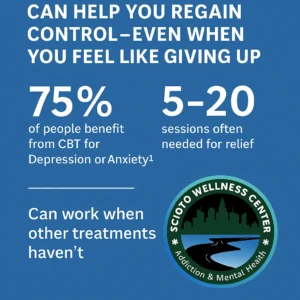
Many people notice changes within 5 to 10 sessions, but outcomes vary. CBT is a short-term, goal-focused therapy, and the timeline depends on your needs and goals.
Do I need a diagnosis to start CBT?
No. You don’t need a formal diagnosis to benefit from CBT. If your thoughts or emotions are interfering with your life, CBT can help—even if you’re not sure what to call it.
Is CBT therapy covered by insurance?
Yes, most major insurance plans cover CBT when provided by licensed therapists. Our team can help you verify your benefits and understand your options.
Can I do CBT therapy online?
Absolutely. At Scioto Wellness Center, we offer both in-person and telehealth CBT sessions for clients in the Hilliard, Ohio area. You can access care from the comfort of your own home.
Ready to Feel Different?
Call (888) 351-9849 or visit to learn more about our CBT therapy services in Hilliard, Ohio. Even if you’re unsure, even if you’re tired—there’s still something here for you.