

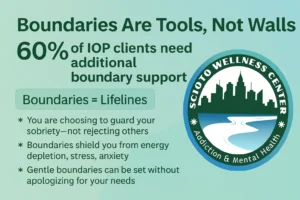
Boundaries are not walls. They’re lifelines.
When you’re in Intensive Outpatient Treatment, the risk of overextending yourself—emotionally, socially, physically—goes up. You may feel pressure to “be there” for everyone else, to not disappoint, to not rock the boat. But if you overcommit, your recovery often pays the price.
If you’ve drifted away from sessions, felt your resolve slipping, or started questioning whether you “deserve” space, you’re not alone. Many people in the middle of treatment face this. Setting boundaries isn’t selfish—it’s protective. Below are deeper practices and mindset shifts to help you guard your sobriety while still living and healing.
Recognize What Boundaries Are Actually For
Boundaries don’t keep everyone out. Boundaries define what is safe, what is permissible, and what is harmful. They help you stay in your center even when the world demands more than you can give.
In IOP, demands come from all sides: family expectations, social obligations, emotional triggers from others, your own inner critic. Boundaries become the guardian shields between your healing edge and the chaos that might knock you off balance.
Seeing boundaries as tools of preservation helps you shift from “I have to” to “I choose to.”
Inventory What You Need to Protect
Before drawing any lines, first map the territory of your overwhelm.
Ask:
- What moments or relationships consistently drain me?
- Which demands pull me away from meetings, therapy, rest?
- Where have I historically compromised myself to keep the peace?
Write these down. Be specific. “Checking group chat late at night,” “taking crisis calls on my off hours,” “agreeing to social plans when I’m emotionally flat.”
Once you see the patterns, you can decide where to begin. You don’t have to set every boundary at once. Start where the pressure is greatest.
Use Gentle Declarations, Not Apologies
Many people in treatment worry that setting boundaries will be received as rejection, selfishness, or abandonment. So they water down their words—or apologize for needing space.
Try this instead:
Clear statement:
“I’m in IOP right now, and my recovery has to come first in these weeks.”
You don’t need to say “I’m sorry” for needing what you need. That honesty is brave. It sets a tone. It honors your process.
You may meet confusion, resistance, or disappointment from others. That’s not your failure. Your responsibility is to be clear, kind, and consistent.
Build “Recovery Buffer Zones”
Buffer zones are times or spaces you protect from external pressures so you can recover.
Some examples:
- After a session: no errands, no checking messages, no obligations for 30 minutes.
- Before a session: intentional preparation—breathing, journaling, grounding.
- Evenings during IOP weeks: low energy hours where you’re not available.
Buffer zones act like a soft boundary around your psyche. They help you land after high-intensity work. They make the rest of life less jarring.
The “Soft No” and the “Firm No”
Boundaries come in degrees.
A soft no lets you decline gently without burning bridges.
Example:
“I appreciate your support, but I’m not up for that right now.”
A firm no is for when “soft” won’t hold.
Example:
“I cannot take on that responsibility while I’m in treatment.”
You don’t owe anyone a detailed justification. Politeness is okay. Vagueness is okay. What’s not okay is you hurting yourself by overcommitting.
Watch for Boundary Pushback – It’s a Signal, Not a Failure
Whenever you set a boundary, you might see:
- Pushback or resistance from people used to unlimited access
- Guilt trips or emotional persuasion
- Internal self-doubt, “Am I being too rigid?”
All of that is normal. Pushback often means you’ve touched a soft spot—someone’s upset the status quo. That doesn’t invalidate your boundary.
If someone doesn’t respect your limit, that’s their choice. You keep yours. You don’t have to explain or negotiate endlessly.
Use Reflection and Accountability to Strengthen Boundaries
Boundaries are not static. They evolve. Sometimes they slip. Sometimes they break.
That’s part of learning. Use your reflection time to ask:
- Where did I cave?
- What feelings pushed me over the line?
- What do I need next time to hold stronger?
Bring these insights to your therapist, your group, or a trusted peer. IOP offers space to readjust, reassert, re-anchor your boundaries. You’re not doing this work alone.
Disconnect Without Disappearing
Sometimes “protecting” yourself looks like stepping back for a bit—not disappearing forever.
You may need quiet days. You may need less social media. Less checking in. Less emotional labor.
You don’t have to vanish. You don’t have to ghost responsibility forever. You just need to retreat enough to heal, then re-emerge stronger.
If others don’t understand, that’s not your burden to carry. This is your recovery. Your pacing. Your safety.
Reassure Yourself (and Others) of Your Intent
One fear when setting boundaries is: Will I be misunderstood as cold, distant, or uncaring?
You can preempt that by adding a gentle clarifier like:
- “I’m doing this to stay sober, not to push you away.”
- “This boundary is temporary while I heal.”
- “I care about you—but right now I need to protect my recovery.”
These statements don’t weaken your boundary. They humanize it.
You don’t have to explain endlessly. A sentence or two helps maintain connection.
FAQs: Boundaries That Support Recovery in Intensive Outpatient Treatment
Is boundary-setting selfish?
No. Boundaries are not selfish—they’re self-care. Especially in early recovery, your ability to stay grounded depends on how well you guard your energy. When you honor yourself, you often bring more clarity and strength into relationships.
Won’t people get offended?
Some might. And that’s okay. Boundaries will reveal who respects you, who pushes, and who needs distance. Their reaction is their business; yours is to stay true to what you need for sobriety.
What if my boundary slips?
That’s not failure. It’s feedback. A slipping boundary shows where you need more support, more clarity, or more reinforcement. Acknowledge it, learn from it, reassert.
Can I adjust boundaries over time?
Absolutely. As your recovery deepens, what you need to protect evolves. Boundaries can grow softer in some places and firmer in others. The goal is sustainable care—not rigid perfection.
What’s a small boundary I can start with?
Start with time. Protect 15–30 minutes each day where you do nothing—no calls, no thinking about others, no obligations. Even small doses of rest help your nervous system stabilize.
Do I need to tell everyone about my boundaries?
You only need to tell people it’s safe and helpful to tell. You don’t owe all your boundaries to everyone. You can choose who you explain to and how much you share.
You deserve space to heal—without guilt.
Call (888) 351-9849 to learn more about our Intensive Outpatient Treatment services in Hilliard, Ohio. You don’t need to say yes to everything right now. Say yes to protecting yourself.