
You Left Your IOP. Now What?
Your stomach sinks when you think about it.
Maybe it started with one missed session. Then two. Maybe you didn’t plan to leave, but life got loud—and recovery got quiet. Maybe you weren’t ready. Or maybe it just felt like too much.
Whatever the reason, you drifted away. And now you’re wondering if the door is still open.
Let us say this as clearly as possible: It is.
At Scioto Wellness Center’s intensive outpatient program in Hilliard, Ohio, we don’t see dropout as failure. We see it as unfinished business. And we’re still here—ready when you are.
You’re Not Alone: Why People Leave Treatment Midway
There’s this unspoken myth that if you leave treatment early, you “blew it.” But treatment isn’t a straight line. The truth is, a lot of people leave and come back.
Here’s why that happens:
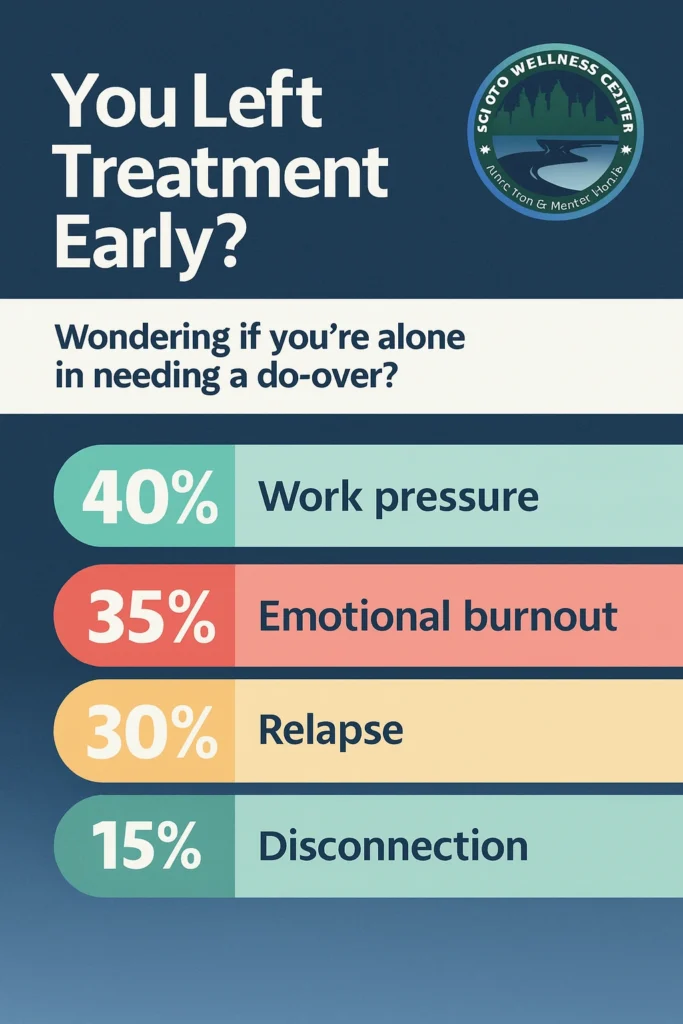
- Life pressure. Work schedules, childcare, bills—real life doesn’t pause for healing.
- Emotional burnout. Sometimes treatment feels like too much, too fast. And it’s easier to hit “pause” than admit you’re overwhelmed.
- Relapse. For some, using again creates shame too heavy to carry through the front door.
- Disconnection. Maybe the group didn’t click. Maybe you weren’t ready to talk yet. That’s not failure—that’s real.
You’re not broken. You’re not banned. You’re just human. And humans need second chances—sometimes third or fourth ones, too.
Why Good IOPs Make Space for the Messy Middle
A quality intensive outpatient program doesn’t expect perfection. It’s designed to hold you through starts and stops. That’s why IOP exists—to give people structure and support while they’re still figuring it out.
At Scioto, we’ve seen people:
- Re-enter after a relapse
- Return after ghosting for weeks
- Re-engage after deciding to try again—even when they weren’t sure it would work
What do they all have in common?
They were welcomed back.
What Reaching Out Actually Looks Like
You don’t need a long apology. You don’t need a perfect reason. And you definitely don’t need to feel “ready.”
It’s okay to say:
“Hi, I was in the IOP a while ago. I left kind of suddenly. Can I come back?”
That’s it. No resume of progress needed. No performance.
Our intake staff knows how hard that first message can be. We’ll walk you through the next steps, no pressure.
You Won’t Have to Start Over From Scratch
One common fear we hear:
“Do I have to start over completely?”
The answer: Not always.
Depending on how long you’ve been away and how you’re doing now, we might:
- Resume where you left off
- Adjust your schedule or care plan
- Offer a fresh start if that feels right to you
And if your needs have changed—emotionally, mentally, or logistically—we’ll adapt. That’s the beauty of outpatient care: it bends with your life, not against it.
The Emotional Weight of Walking Back In
We won’t sugarcoat this: walking back into a space you left can feel awkward. Maybe even shameful.
But awkward doesn’t mean you don’t belong.
“I thought they’d judge me for leaving. Instead, my counselor just smiled and said, ‘I’m glad you’re back.’”
– IOP Client, 2023
That’s not a rare reaction. That’s how healing communities are supposed to work. No shaming. No rehashing. Just a hand on the door saying, “Welcome.”
You’re not coming back because you failed. You’re coming back because you want something better. That’s courage—not weakness.
What Changes the Second (or Third) Time Around?
Every time someone returns, something’s different. Not because they’ve figured it all out—but because they’ve seen something. Felt something. Missed something.
Sometimes that “something” is structure.
Sometimes it’s being heard.
Sometimes it’s the way you felt for an hour after group—the sense that you weren’t carrying everything alone.
That memory is a breadcrumb. And following it back isn’t regression—it’s wisdom.
Quick Tips for Returning to IOP After Dropping Out
Tips From Clinicians Who’ve Seen It All
- Start small. A text. An email. A call. That first reach-out is the hardest step.
- Skip the shame spiral. You don’t owe anyone perfection. Just honesty.
- Ask what’s possible. Don’t assume you know what re-entry will look like. Programs evolve—and so do you.
- Trust your discomfort. It means you care. That’s a good sign.
- Let us meet you where you are. Not where you “should” be.
Why You Might Feel Stronger This Time
Leaving treatment doesn’t mean you lost everything. Some things stick, even if you didn’t realize it. Boundaries. Words from a group member. A sense of what safety feels like.
When you come back, you’re not starting over. You’re starting again. There’s a difference.
And you’re doing it with more insight than before.
Real People. Real Returns.
One woman left after three sessions. She ghosted for two months, convinced she’d “wasted their time.”
When she came back, she finished the full program. Then she became a peer support volunteer.
Another client left after a hard group. The grief was too much. Six weeks later, he returned—not fixed, but ready to face it with support.
Your story isn’t over because you paused.
It just turned a page.
FAQ: Re-Entering IOP
Can I really come back if I left without notice?
Yes. No punishment. No lecture. We want you to come back, not feel bad about leaving.
Will I have to start over from the beginning?
Not necessarily. We’ll assess where you’re at and figure out what makes sense. Sometimes we can resume. Other times, a new plan is best.
What if I used again after leaving?
That doesn’t disqualify you. Many clients relapse before recovery sticks. We’re here to help, not to judge.
Do I need insurance again?
Possibly. We’ll walk you through options, including re-verifying coverage or discussing payment plans.
Will the group judge me?
Most clients have been in your shoes. You’d be surprised how much support shows up when you return. Vulnerability builds trust.
What should I say when I reach out?
Keep it simple. “I was in your IOP a while ago. I’d like to come back. Is that possible?” That’s more than enough.
The Door Is Still Open
You don’t have to earn your way back in. You don’t have to explain everything.
Just call. Text. Ask.
📞 Call (888) 351-9849 or visit Scioto Wellness Center’s intensive outpatient program in Hilliard, Ohio to learn more about re-engaging with care. We’ll meet you where you are—not where you left off.