

You may have carried anxiety so long it feels like part of your identity. Going to Scioto Wellness Center’s anxiety therapy might feel like stepping into unknown terrain. But once you begin, things start shifting in real ways—often quietly at first, then with momentum. You don’t lose yourself—you begin to find yourself again.
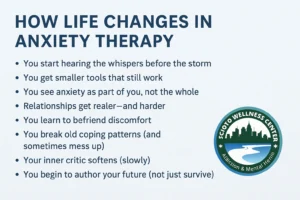
Here are 8 real ways your life can change once you commit to anxiety therapy.
1. You Start Hearing the Whispers Before the Storm
Before therapy, your body probably screamed before you ever registered what was wrong: racing heart, sweat, panic, overwhelm.
Therapy helps you tune in earlier. You begin to notice:
- A tightening at the base of your throat
- A slight jump in your breath
- An uneasy stirring under your ribs
These whispers become your early warning system. Over time, you learn to act before the storm arrives. That’s real power.
2. You Get Smaller Tools That Still Work
You’ll hear talk of big breakthroughs—but most of anxiety therapy is about micro-practices: 30 seconds, 60 seconds, 5 minutes.
- Slowing your breathing
- Noting your feet on the ground
- Naming a feeling (“this is tension”)
- Letting a thought pass without grabbing it
These aren’t flashy, but they become reliable—even on days when nothing else feels possible.
3. You See Anxiety as Part of You, Not the Whole
Many of us live in spiritual or emotional binaries: “I’m anxious = I’m broken.”
Therapy helps you separate the symptom from your identity. You begin to say:
“I have anxiety.”
“Anxiety makes demands, but it’s not the sum of me.”
Once that shift takes root, the pressure to “erase anxiety completely” softens. You live with it, not under it.
4. Relationships Get Realer—and Harder
When you show up more truly, your relationships shift.
Some people lean in. They say, “I see you.”
Some drift away because they preferred the version of you who numbed.
Some conflict arises when boundaries you couldn’t hold before now matter.
It’s disorienting—but necessary. Part of your journey is learning which relationships nourish you and which ones pull you off center.
5. You Learn to Befriend Discomfort
Anxiety therapy often flips the script: discomfort isn’t always danger. You begin to learn that sitting with fear, rather than reacting to it, builds resilience.
On good days, you’ll notice discomfort soften instead of spike. You’ll pause instead of fleeing. You’ll find your edges—not to numb them, but to grow through them.
6. You Break Old Coping Patterns (and Sometimes Mess Up)
One big shift is dumping what’s not working—even if it’s familiar.
That might mean:
- Reducing screen time
- Saying no to people-pleasing
- Letting go of self-harm behaviors or numbing substances
You may stumble. You may regress. That’s expected. Therapy helps you pick up, reflect, reassert. Change is rarely neat.
7. Your Inner Critic Softens (Slowly)
If you’ve carried anxiety, you’ve likely been tough on yourself. Therapy often brings a gradual shift:
- The voice of judgment gets replaced by curiosity
- “Why didn’t I do better?” becomes “What was happening in me then?”
- You notice less shame, more compassion
It doesn’t happen overnight. But over many sessions, you’ll catch yourself less often in harsh loops—even on tough days.
8. You Begin to Author Your Future (Not Just Survive)
Maybe therapy starts as survival—getting through the nights, calming panic. But over time, it becomes something more.
You start writing decisions grounded in desire, not fear. You imagine possibilities. You experiment. You say, “What if I could…?” and actually try.
You don’t just endure anxiety. You build a life that includes it—but doesn’t defer to it.
FAQs: What to Expect in Anxiety Therapy
Do I need to be “broken” to start therapy?
No. You don’t have to hit crisis to benefit. Therapy is for anyone feeling anxious, stuck, overactive, or overwhelmed—even when people see you as “doing fine.”
How quickly will I feel different?
There’s no set timeline. Some shifts happen in a few sessions. Others take months. The changes above often begin subtly and grow over time.
What if therapy makes me feel worse first?
That’s common. Opening closed doors brings emotion, discomfort, old wounds. It doesn’t mean therapy is failing—it often means real work is happening.
Can therapy help with sleep, relationships, or substance use too?
Often yes. Anxiety weaves through many areas of life. As you untangle its roots, things like rest, connection, impulses begin to shift too.
What keeps me from quitting too early?
Consistency more than motivation. Doing small practices even when you don’t feel like it builds trust with yourself. Therapy is a commitment to your whole life, not a quick fix.
Your anxiety didn’t come overnight—and healing won’t either. But each step in therapy is a thread woven toward something stronger. You don’t have to erase fear to live with depth, authenticity, curiosity, and courage.
When you’re ready, we’re here. Call (888) 351-9849 to learn more about our Anxiety Therapy services in Hilliard, Ohio. You’re not alone. You’re not the weird one. You’re someone reaching for more.