

When you first heard “you have anxiety,” the world probably flipped a little. Maybe your chest clenched. Maybe you thought: Now what? Does this mean every day will be crawling through fear? Does this mean I’ll have to take pills forever?
What I want you to know is: that diagnosis is not a sentence. It’s a signpost. And with anxiety therapy, it can be the hinge where your life pivots from surviving to living more fully.
Here’s how I’ve walked alongside people in these first days—and what many discover when they lean into the process.
The Diagnosis Names What’s Hidden
For so long, you felt something was off—but you couldn’t name it.
You knew your heart raced. You knew you’d avoid things. You knew your brain spun at night. But you carried a secret anxiety that whispered you were just weak, or overreacting.
The diagnosis gives you a name. It gives you language. It gives you permission to stop beating yourself up for things you couldn’t name before.
And naming is powerful. Because once something is named, it can be addressed. Once it’s named, it loses some of its fear.
Therapy Doesn’t Replace You — It Supports You
You may fear therapy means changing who you are. Or that it means admitting you’re broken. But good anxiety therapy is less about replacing you and more about helping you find your way back to yourself.
You begin to understand your patterns, your automatic responses, your fears. You learn not to fight yourself, but to guide your nervous system. You don’t lose your identity. You recover it.
In therapy, you’ll find tools to reduce suffering—not diminish your uniqueness.
The First Shift Is Often in Awareness
In early therapy, people often report one surprising change: suddenly noticing more.
- You feel the tightness in your chest before it becomes full-blown panic.
- You catch your mind spiraling before you fall deep.
- You sense triggers (people, places, times) before they hijack you.
Therapy helps you grow a “radar”—early detection, so you can intervene before the flood. This awareness is not a burden. It’s your first line of defense.
Accepting Help Doesn’t Make You Weak
One of the biggest fears people voice is: If I let medication or therapy help me, am I admitting I can’t handle my life?
No.
Medication is a tool. Therapy is a companion. They are not admissions of failure. They are acts of courage.
According to clinical guidance, psychotherapy and medications are two main pillars in treating anxiety—and combining them often gives the best results.
Think of them like training wheels—not permanent, maybe helpful while building strength.
You’ll Relearn Trust With Your Body
Anxiety often teaches you to distrust yourself. “Am I safe? Are my body signals real or false alarms?” You second-guess your own experience.
In therapy, you learn safety. You practice grounding, breathing, body awareness. You re-learn to trust that your heart racing doesn’t always mean catastrophe. You learn that you can sit with discomfort long enough to see it move through.
And bit by bit, your body stops betraying you.
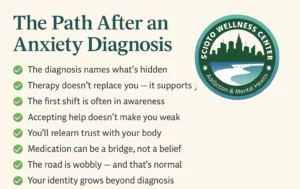
Medication Can Be a Bridge, Not a Belief
If medication is part of your journey, it’s okay to be scared. Start slow. Ask questions. Understand side effects and goals.
Medication doesn’t have to be forever. Some people use it temporarily while therapy builds capacity. Others find it helpful longer. Either way, it doesn’t erase your strength. It can be a stabilizer when your capacity is still low.
Over time, many people reduce or taper, leaning more on the skills therapy instills. The key is: keep your agency. Ask, “What’s working? What do I feel? What do I want to change?”
The Road Is Wobbly — And That’s Normal
When you begin therapy, you often dip into harder places.
You may feel worse before better.
You might revisit long-buried grief, fears, regrets. You’ll re-encounter defenses you built to survive. You might feel vulnerable, exposed, raw.
All of that is part of healing—not failure.
What matters isn’t how steady you feel. What matters is that you return. You continue. You lean in again.
Your Identity Grows Beyond Diagnosis
At first, anxiety may feel like your defining feature. But therapy cracks that.
You begin to rediscover what matters: your values, dreams, quirks, strengths. You reclaim parts of yourself anxiety made you hide.
You start making decisions not from fear—but from intention. You choose relationships, work, routines that nourish. You let some parts of life shift.
Eventually, anxiety becomes one part of your being—not the whole.
Community Becomes Real
One of the most healing discoveries is that you’re not alone. That other people carry versions of what you feel. That rooms exist where people lean toward your pain instead of away.
Therapy connects you to that. You hear words you thought only you whispered. You see others’ faces flush with fear, hope, courage. You begin to realize your diagnosis doesn’t isolate you—it connects you.
You begin walking in circles that carry you forward, not push you backward.
FAQs: Early Steps After an Anxiety Diagnosis
Do I have to commit to therapy long-term?
Not necessarily. You might start with a few months. You might pause. You might revisit. What matters is depth, not duration. Early intervention increases long-term gains.
Will medication rob me of creativity or emotion?
Not usually. Many people fear “flattening.” But with careful dosing, thoughtful monitoring, and open communication, medication can calm the background static so your true mind can breathe.
What kind of therapy is best for anxiety?
Cognitive-Behavioral Therapy (CBT) is a gold standard. It helps reframe fearful thinking, practice exposures, and test fear-driven beliefs. Some clients also benefit from exposure therapy, metacognitive approaches, or mindfulness-based modalities.
How do I handle therapy fatigue when progress feels slow?
Therapy is marathon work. Take breaks. Use buffer supports (journaling, meditation, walks). Share these feelings in therapy—they’re part of the process. Often fatigue signals depth, not failure.
Can therapy help prevent relapse or worsening later?
Yes. Because therapy builds skills, resilience, and insight, people who engage early often reduce risk of relapse or escalation.
You may have received your diagnosis thinking it closed doors. But in many ways, diagnosis is the opening of possibility—a threshold where you choose to move toward something better, piece by piece.
You don’t have to rush. You don’t have to erase fear overnight. But you do get to lean into support, ask questions, make allies with your body, with skilled therapists, with tools you’ll carry forward. There’s no shame in needing help. There’s power in showing up for yourself.
When you’re ready, we’re here.
Call (888) 351-9849 to learn more about our Anxiety Therapy services in Hilliard, Ohio. Your diagnosis isn’t your ending—it might just be your doorway.