

You walked into IOP hopeful. You showed up for the first session believing you could change.
Then life chipped in: demands, expectations, people’s pain, your own fatigue. You found yourself slipping. Ghosting. Pulling away.
But boundaries are not betrayals—they’re the scaffolding that hold your sobriety when everything else feels too heavy.
If you’ve pulled back from IOP or felt yourself unraveling mid-treatment, this is for you.
1. Recognize the Spaces Where You Habitually Lose Yourself
Your boundaries won’t hold if you don’t see where they’ve collapsed before.
Think through the moments when you’ve ended up drained, resentful, or triggered. Maybe it’s staying late in emotional conversations. Taking on other people’s crises. Showing up when every fiber in your body wants to heal.
Write out those “repeat zones.” Those are your boundary battlegrounds.
If you’ve been ghosting group, maybe your boundary was the emotional ride-share home, the late phone calls, the oversharing before you were grounded.
Once you see the pattern, you can begin drawing clearer lines around it.
2. Use Short, Clear Statements—Don’t Over-Explain
The more you justify, the more people push. The more you apologize, the more your boundary gets blurred.
Use clarity:
“I’m in IOP now, so I need to pause this discussion.”
“I can’t respond after 10 p.m.—I need rest to stay sober.”
“I’m protecting my recovery today and won’t be available for extra support calls.”
That’s it. That’s enough.
You don’t owe long stories or emotional labor to maintain your boundary. Clarity respects both you and the other person.
3. Carve Recovery Buffer Zones in Your Day
Without buffer time, your emotional system becomes a highway with no exits.
Design pockets in your schedule where you are not available—to anyone or anything:
- Right before or after group
- One hour midday
- Late evening wind-down
- First minutes after waking
During these windows: no phone, no obligations, no emotional labor. Sit, breathe, journal, rest. These buffers are sacred—they let you land inside your own container.
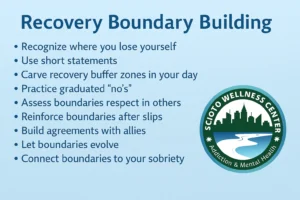
4. Practice Graduated “No’s”: Soft Then Firm
You don’t always need a full stop. Use a tiered approach:
- Soft Refusal: “I appreciate it, but I’m not available now.”
- Firm Boundary: “I cannot do this while I’m in IOP. Please respect that.”
- Escalation: If the line continues to be crossed, you may need to suspend communication or set stronger distance.
That “laddered boundary” model gives you flexibility when you’re fragile and firmness when you need it.
5. Assess Who Respects Boundaries—and Who Doesn’t
Boundaries are litmus tests for relationships. Some people will adapt gracefully. Others will resist, guilt-trip, or push.
When someone dismisses your boundary, pay attention. Not as a moral judgment, but as data about how safe that relationship is for this season of recovery.
That doesn’t always mean cutting ties. But it might mean limiting their intensity, leaving some doors half-ajar, or putting distance until trust rebuilds.
6. Reinforce Boundaries if They Slip
Slips will happen. You’ll agree to something you shouldn’t. You’ll forget. You’ll overextend.
When that happens, don’t shame yourself. Don’t pile guilt. Use that moment as feedback:
- Notice what led to the lapse.
- Name what was asked of you and why your boundary couldn’t hold.
- Reassert: “I need to pull back. I need space. I’m sorry I overstepped.”
Every slip is a chance to strengthen your boundary muscles. Recovery includes course correction—not perfection.
7. Build “Recovery Agreements” with Allies
You don’t need to battle boundaries alone. Invite supportive people into your space by creating mutual agreements:
- “During IOP weeks, text me before bringing up serious conversation.”
- “I’m avoiding substance talk. Please don’t mention drink plans around me.”
- “If I’m missing sessions, I’ll reach out tomorrow—not tonight.”
These agreements protect your space while showing others how to meet you. They reduce confusion, friction, and argument.
8. Let Boundaries Evolve — Don’t Over-Fix Them Forever
Early in recovery, your boundaries need to be firm—maybe rigid. As your safety strengthens, they can soften.
Ask regularly:
- Which boundaries still feel valuable?
- Which feel too tight now?
- What would I allow now that I couldn’t before?
That kind of reflection lets you reclaim freedom without overextending. Boundaries can be dynamic.
9. Connect Your Boundaries to Your Why (Your Sobriety)
Boundaries without purpose feel arbitrary. But when anchored to your recovery, they become sacred.
Ask:
- How does this boundary protect my sobriety?
- What harm am I preventing by holding this line?
- What does this boundary let me keep—for myself?
When people ask, “Why this?” you don’t owe long answers. But having your internal purpose helps you stay rooted.
10. Lean Into the Discomfort — It’s a Sign of Growth
Setting boundaries will feel odd. People will test. You’ll feel guilt, fear, rejection.
That’s normal. Discomfort is your nervous system learning a new language. You’ll grow out of old patterns.
When urges rise to cave, lean into the space. Pause. Breathe. Ask: Will this protect me tomorrow? That tiny pause often wins more than reaction.
FAQs: Boundaries & IOP in Recovery
Is boundary setting unkind or selfish?
No. It’s self-protection. Especially during IOP, you need structure that holds you. When you can’t regulate from your center, you can’t truly show up for others anyway.
Will people resent me if I assert limits?
Probably some will. Some might resist or push. That doesn’t mean you’re wrong. Their reaction is part of their internal work—not your boundary’s fault.
How many boundaries should I set?
Start with 2–3 major zones (time, emotional labor, crisis-check-ins). Solidify those first before adding complexity. Depth beats breadth.
Can boundaries shift mid-treatment?
Yes. Boundaries should flex as your resilience strengthens. What you needed in week one might loosen by week six. Always re-evaluate.
What if I draw a boundary and still get pulled across it?
Then your boundary wasn’t clear enough—or the other person didn’t hear it. Reassert firmly. If it’s still ignored, escalate distance as needed. Your sobriety deserves the line being honored.
You didn’t ghost IOP to hurt people. You slipped because your system got overwhelmed. Now you can stay present—on your terms—with clarity, protection, and courage.
Call (888) 351-9849 to learn more about our IOP services in Hilliard, Ohio. You deserve boundaries that heal, not harm—and a recovery that allows you to hold your space.