
You left. Maybe quietly. Maybe abruptly.
Maybe you told yourself you’d come back in a week.
Or maybe you just stopped answering texts, stopped logging in, stopped showing up—and hoped no one noticed.
If you’re reading this, it means something inside you still wants to heal.
This isn’t a call-out. This is an invitation.
At Scioto Wellness Center, we see the emotional weight that comes with dropping out of an Intensive Outpatient Program (IOP). The guilt. The awkwardness. The fear that it’s “too late” to come back.
But it’s not too late.
You’re not the exception.
And you’re still welcome here.
Here’s how to let go of guilt and gently begin again.
Guilt Is Heavy—And It’s Not Helping You Heal
Guilt tells you that you did something wrong.
But shame? Shame tells you you are wrong. And that’s the voice most dropouts are fighting.
- “I knew better.”
- “I let everyone down.”
- “They probably gave up on me.”
These thoughts aren’t truth. They’re defense mechanisms. When we feel like we failed, it’s easier to push ourselves further away than to risk reaching out and being rejected.
But in reality? Guilt and shame keep you stuck.
Healing starts when you stop asking whether you deserve another shot—and start asking what kind of support will actually help you move forward.
You Don’t Have to Earn a Second Chance
One of the most common myths we hear from returning clients is that they need to be “in a better place” before they can come back.
But recovery doesn’t work like a merit badge system.
You don’t have to prove your worth. You just have to show up.
You can come back to IOP:
- If you’re using again.
- If you feel more chaotic than when you left.
- If you’re scared it won’t work.
There’s no application. No clean-slate requirement.
Just a door—and it’s still open.
What Actually Happens When You Come Back
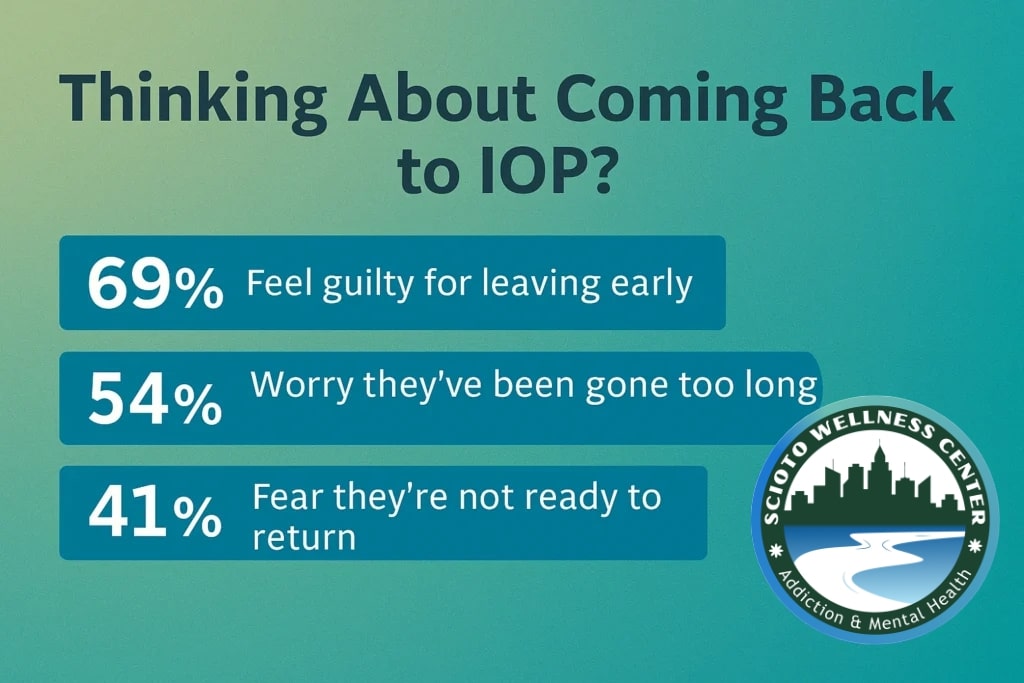
This is where fear takes over for a lot of people.
You start imagining worst-case scenarios.
- That you’ll walk in and be shamed.
- That people will ask, “Where have you been?”
- That the staff will be disappointed.
- That your old group will treat you differently.
But the truth is far simpler—and kinder.
Clients who return often hear:
“Hey—it’s good to see you.”
That’s it. No grilling. No ceremony. Just a quiet welcome.
Our clinicians understand what it means to leave mid-treatment. Life pulls hard. And sometimes, we’re not ready until we’re ready. Your seat is still there. Your story is still unfolding.
You’re Not the Only One Who Left
It might feel like you’re the only one who dropped out, but you’re not.
So many people leave before finishing IOP:
- Because they thought they were okay.
- Because something else became urgent.
- Because they panicked and needed space.
- Because the work felt too hard.
What matters isn’t whether you left—it’s whether you’re still open to coming back.
One of the most powerful transformations we see at Scioto Wellness Center comes from clients who return. They’ve faced their own resistance. They’ve sat with the guilt. And they still chose to reengage.
That takes courage.
You Don’t Have to Start Over—You Get to Continue
Another barrier for returners is the fear that they’ll be “back at square one.”
You won’t be.
When you return to our Intensive Outpatient Program in Hilliard, Ohio, our team meets with you first—not to review your mistakes, but to understand where you are now.
We talk about:
- What worked before
- What got in the way
- What kind of support you need this time
You don’t lose the insights you gained. You don’t erase the progress you made.
You bring it all with you—and we build from there.
Recovery Is Nonlinear—and That’s Normal
Here’s something we wish more people knew: recovery rarely goes in a straight line.
You might:
- Take two steps forward, then fall back into old habits.
- Show up strong for a month, then disappear.
- Leave IOP with the intention to stay sober—and relapse within a week.
This doesn’t mean treatment failed.
It means life is real, and healing takes time.
Our role as clinicians isn’t to judge that.
It’s to keep the door open so you can walk back through it.
Start With One Small Step
If rejoining IOP feels too big right now, try this instead:
- Call and ask, “Can I just talk to someone about returning?”
- Email and say, “I’m not sure I’m ready, but I’m thinking about coming back.”
- Visit and ask for a copy of the schedule or to meet with a counselor.
You don’t need to jump back in full-time.
You just need to take a step closer to support.
That first step—quiet, brave, awkward—is where everything begins again.
Returning Can Be the Strongest Decision You Make
We’ve had returning clients say things like:
“I thought leaving meant I failed. But I wasn’t ready then. I am now.”
“I ghosted everyone because I was ashamed. And no one shamed me when I came back.”
“This second time around, I know what I need—and what I don’t.”
Coming back to treatment isn’t weakness.
It’s one of the most courageous moves a person can make.
You already know the hardest part of healing: facing yourself.
You’ve done that before. You can do it again.
FAQ: Coming Back to IOP After Dropping Out
Will I have to explain why I left?
Only if you want to. There’s no required confession. You can share what feels relevant—or nothing at all. Our team will meet you where you are.
Do I have to start over?
No. You won’t be “reset” or placed back at square one. We’ll work with you to assess where you are now and create a plan that reflects your progress and needs.
What if I’m using again?
That’s okay. You don’t need to be sober to return. Many clients come back while still struggling. IOP is here to help you get stable, not punish you for relapsing.
Will my old group judge me?
Most clients are just glad to see you again. And if returning to the same group feels too vulnerable, we can talk about alternative tracks.
Can I just come in for a conversation before committing?
Absolutely. We encourage it. We’re happy to talk with you, answer questions, and explore what returning could look like—no pressure.
Does insurance cover returning clients?
Often, yes. Our admissions team can verify your benefits, review your history, and walk you through what’s covered.
You’re Still Allowed to Heal
Whatever happened before—however long you’ve been gone, however messy things feel right now—it doesn’t disqualify you.
You are still allowed to:
- Ask for help.
- Change your mind.
- Return to treatment.
- Start over as many times as you need.
The guilt you’re carrying? You don’t have to bring it with you.
Leave it here. We’re not holding it against you.
What we are holding is space—for you to return, just as you are.
Ready to reconnect with support?
Call (888) 351-9849 or visit Scioto Wellness Center’s Intensive Outpatient Program to talk about returning to care in Hilliard, Ohio. No judgment. No shame. Just a path forward.