
When your child is using again, your heart doesn’t stop loving—but it does start breaking in new and more complex ways.
You’ve done the right things. Therapy. Treatment. Support groups. Boundaries. Grace. But now it feels like you’re watching someone you love slip through your fingers all over again.
And maybe you’re asking yourself questions you never thought you’d have to revisit:
Should I let them move back home? Should I pay for their phone? Should I stop taking their calls?
The answers feel impossible. Because the rules keep changing. And no matter what you choose—support can start to feel like enabling. And doing nothing can feel like abandonment.
At Scioto Wellness Center, we walk alongside parents at exactly this point. And in our partial hospitalization program in Hilliard, Ohio, we help families untangle the difference between help that heals and help that accidentally holds someone back.
When Love Becomes a Tightrope
There’s no manual for parenting a 20-something in active addiction or emotional crisis. Especially when the outside world tells you they’re “an adult now.”
Yes, your child is grown. But that doesn’t mean you stop being a parent. And it definitely doesn’t mean you stop feeling responsible for what happens next.
But here’s the hard truth: sometimes, love gets loud in all the wrong ways. It fills in the cracks. It covers up the consequences. It tries to fix things too soon—because watching someone fall is unbearable.
But if you catch them every time, they may never learn how to stand.
This isn’t about blame. This is about building a support system that actually works—for both of you.
What’s the Real Difference Between Support and Enabling?
Let’s break it down in plain terms:
Support helps your child move toward health.
Enabling unintentionally shields them from the impact of their choices.
Support might look like:
- Saying no to giving them cash, but offering a ride to treatment
- Setting a curfew or house rules—and sticking to them
- Allowing them to experience consequences (like job loss or missed court dates) without rescuing
Enabling might look like:
- Paying their rent while they continue to use
- Lying for them to friends or employers
- Giving second, third, or tenth chances without conditions or change
Both come from love. But one leads toward recovery—and the other prolongs the spiral.
The good news? You don’t have to guess where the line is. In PHP, we help you find it.
Why This Is Especially Hard With Young Adults
The hardest part about parenting a young adult who’s struggling is the in-between-ness of it all.
They’re too old to ground. Too young to always get it right. Old enough to make decisions. Young enough to need help. And when substances or mental health challenges show up, that tension gets sharper.
They may say things like:
- “I don’t need you in my business.”
- “You don’t understand what I’m dealing with.”
- “It’s my life. Stay out of it.”
And yet—they still call when they’re out of money. They still show up at 11 p.m. with nowhere to go. They still expect you to help—without wanting to be held accountable.
That’s not just hard. That’s agonizing.
A partial hospitalization program can break this exhausting loop.
How a Partial Hospitalization Program Changes the Dynamic
At Scioto, our PHP creates space—for your child to grow, and for you to breathe.
Here’s how it works:
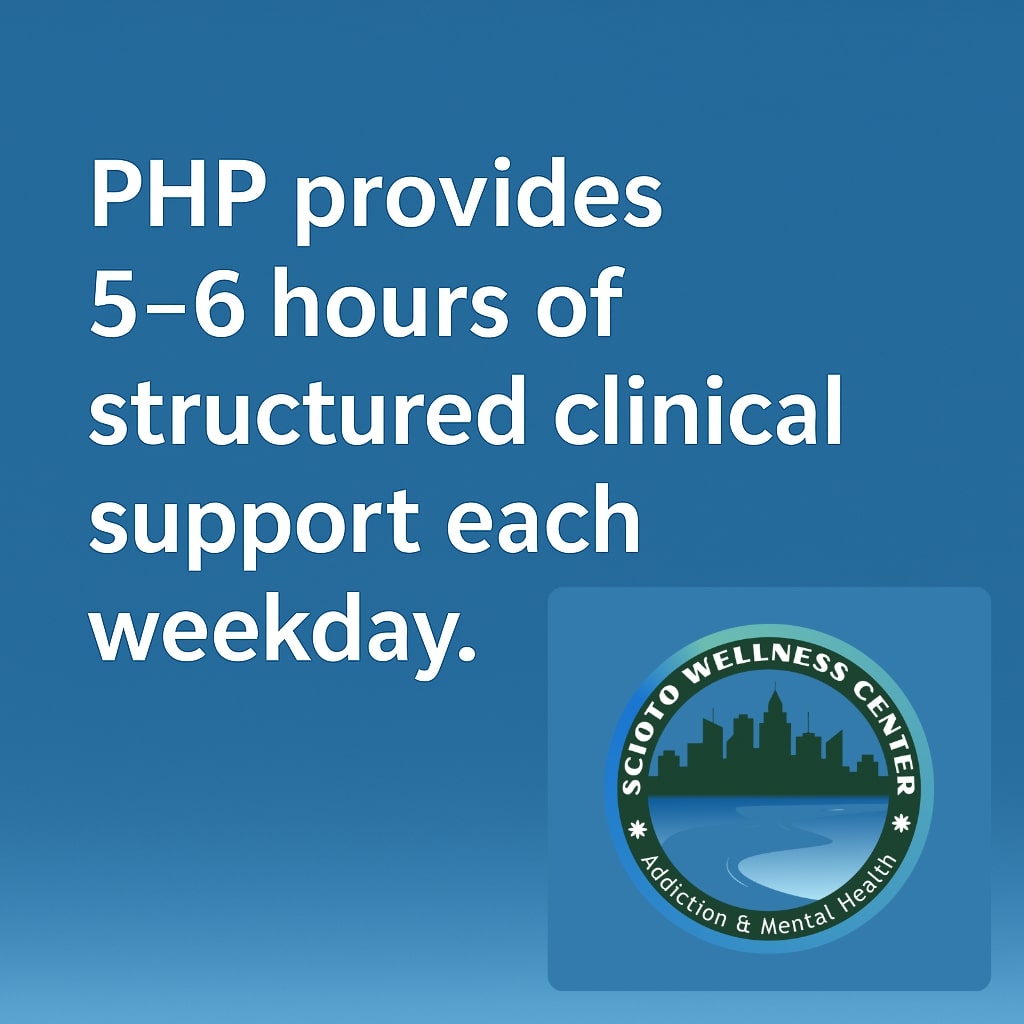
- Daytime treatment: Your child attends programming 5–6 hours a day, Monday through Friday. This includes individual therapy, group therapy, clinical assessments, and skills training.
- Evening flexibility: Clients return home at night, giving them a chance to practice what they’re learning in a real-world setting—while still staying connected to care.
- Family inclusion: You’re not frozen out. Our clinical team works with you to provide updates, support communication, and help you reset boundaries with clarity and care.
The result? Your child is being held—just not solely by you. And you get to step back without stepping away.
PHP Gives Your Child More Than Just “Treatment”
If you’re picturing a sterile setting or a hospital bed, let us stop you right there.
PHP isn’t a punishment. It’s a structured, intentional environment where young adults learn how to:
- Tolerate discomfort without numbing
- Take responsibility without collapsing
- Communicate without blowing up or shutting down
- Show up even when they don’t feel like it
- Rebuild trust slowly and with substance
It’s not magic. But it is powerful. Especially when you’re tired of being the one trying to hold it all together.
You Are Not Weak for Wanting a Break
We need to say this clearly: If you feel like you’ve hit your wall—you’re not failing your child.
You’re being human.
Many parents of young adults in crisis live in a chronic state of fear and fatigue. You’re used to scanning every silence for signs. You know what it means when they stop answering texts. You brace every time the phone rings.
That’s not parenting. That’s survival mode. And it’s no way to live—for either of you.
PHP allows you to shift out of constant crisis response and into something steadier. It gives your child a team. And it gives you a chance to start recovering, too.
What If They Don’t Want It?
This is often the hardest part.
Maybe your child says they don’t need help. Maybe they say “treatment didn’t work” last time. Maybe they swear they’re fine—right after another sleepless night or failed job.
That doesn’t mean they’re lost forever.
Here’s what we tell parents in your shoes: You can’t force change, but you can remove the conditions that protect the problem. That means holding boundaries around:
- Housing
- Transportation
- Financial support
- Communication expectations
Our team can help you craft boundaries that are firm, clear, and rooted in love. You don’t have to do it alone.
FAQs: Parents and Partial Hospitalization Programs
Is PHP like inpatient rehab?
No. PHP is outpatient-based. It offers intensive care without requiring overnight stays. It’s a strong option for young adults who need structure and support but not 24/7 supervision.
What if my child refuses to participate?
You can’t force it—but you can create conditions that make change more likely. Sometimes, refusing to continue enabling behavior opens the door to treatment. We can help guide you through that.
Will I still be involved in their care?
Yes. With your child’s consent, our clinical team provides updates, invites you to participate in family sessions, and offers education to help you support recovery without over-functioning.
Is this just about addiction, or does PHP help with mental health too?
PHP supports clients with substance use, mental health issues (like depression, anxiety, PTSD), or both. Many young adults are navigating complex emotional pain. We’re equipped to help.
Do you judge parents?
Never. We know you’ve done everything you could with what you had. We’re here to support—not shame.
If You’re Reading This, You’re Still in the Fight
The fact that you’re even asking these questions—the fact that you’re still here—means your love is strong. But strength doesn’t mean doing it all yourself. And it doesn’t mean going one more round with chaos just to prove you care.
You’re allowed to set the boundary.
You’re allowed to step back.
You’re allowed to say: We need more help than I can give alone.
And you’re allowed to do that with love—not guilt.
Call (888) 351-9849 to learn more about our partial hospitalization program services in Hilliard, Ohio.