
You didn’t expect to step away from treatment—but life got messy.
Maybe it started with a missed group session. Then two. Then three. And before you knew it, your calendar was full, your motivation low, and your IOP attendance? Nonexistent.
Now you’re thinking about coming back. That thought alone means something important: you still care. You’re still in this.
At Scioto Wellness Center’s Intensive Outpatient Program in Hilliard, Ohio, we work with people who stop and restart all the time. Ghosting isn’t failure—it’s often a reflection of how much pressure you’re under.
So if you’re wondering how to return to IOP without feeling judged or like you blew it, this guide is for you.
Step 1: Accept That Ghosting Happens—and It’s Okay
Let’s normalize something that never gets said enough: people ghost treatment programs. It doesn’t mean they don’t care. It means something got in the way.
That “something” might’ve been:
- A new job or shift in schedule
- Burnout from opening emotional wounds
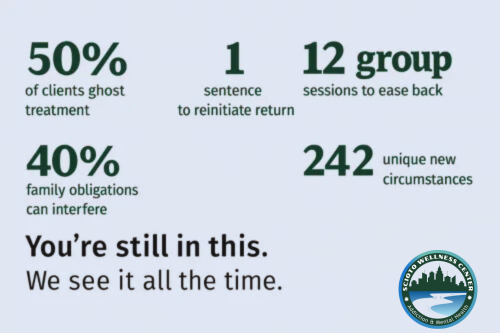
- Family obligations
- A relapse or mental health crash
- Shame that crept in slowly after missing a few sessions
You don’t need to have the “right” reason to come back. You’re allowed to return just because you want to. No performance. No apology tour. Just permission.
Step 2: Reach Out Without Rehearsing a Speech
We’ve seen clients spend days or weeks trying to write the perfect message:
“Should I explain why I left?”
“Do I need to apologize?”
“What if they’re mad?”
Here’s what we actually need from you:
One sentence.
That’s it. You could send a text that says, “I want to come back—can we talk?” And that would be enough.
At Scioto Wellness Center, we never shame someone for leaving. We assume you left for a reason. Our only goal is to help you find your way back—on your terms, in your time.
Step 3: Know You Don’t Have to Start Over
A common fear among returning clients is: “Will I lose all my progress?”
The answer is no. IOP isn’t like school—you don’t fail out. Treatment is cumulative. Even if you missed weeks or months, you still hold:
- The insights you gained
- The tools you practiced
- The emotional groundwork you laid
All of that still lives in you. Coming back just means you pick up where you left off—with support to help you settle back in.
And if what you need looks a little different now? That’s okay, too. We’ll meet you there.
Step 4: Let Yourself Be New—Even If You’ve Been Here Before
You’ve changed. Life has happened. Maybe something big—like a relapse, a breakup, or grief. Or maybe something small but persistent—like fatigue, avoidance, or losing your sense of “why.”
Either way, the version of you walking through the door now is not the same one who walked in last time.
That’s not failure. That’s growth.
You don’t need to explain everything. You don’t need to minimize what’s shifted. Just bring your now-self. We’ll take it from there.
Step 5: You Can Ease Back In—At Your Own Speed
There’s no single way to rejoin an intensive outpatient program. We build around you, not the other way around.
For some clients, easing back in might look like:
- A one-on-one session first, before rejoining group
- Starting with just 1–2 group sessions per week
- Meeting with a different therapist if that feels better
- Shifting to a different group schedule or structure
What matters is that it works for you. We’re flexible, not formulaic.
Step 6: Guilt Will Try to Follow You—Don’t Let It Drive
You’re not alone if you’ve felt a tight, sinking feeling in your stomach about coming back. That feeling has a name: guilt.
It whispers things like:
- “They probably think I flaked.”
- “I messed up. They won’t take me seriously.”
- “I should’ve done better.”
But guilt is a storyteller—not a truth-teller.
The truth is, everyone in this field knows that treatment isn’t linear. We’ve seen hundreds of people ghost and return. And the ones who come back? They’re usually stronger for it.
Let us hold the guilt so you don’t have to carry it alone.
Step 7: Remember That Returning Is Braver Than Starting
When you walked in the first time, you didn’t know what to expect. That takes courage.
But when you come back after ghosting? That takes something deeper: humility and hope. And those two things—together—make for serious momentum.
You’re not just “trying again.” You’re choosing to keep going. That makes you someone who doesn’t give up. Someone who gets up, even after stumbling.
That’s the foundation recovery is built on.
What You Can Expect When You Return
Here’s how it typically goes:
- Reach out — via call, text, or email. We’ll respond warmly and quickly.
- Quick check-in — no huge intake process. Just a few questions about how you’re doing.
- Treatment review — we’ll talk about your goals, scheduling needs, and what support feels right.
- Re-entry — you’ll begin at the pace you’re comfortable with. Group, individual, or both.
No lectures. No shaming. No “where have you been?” vibes. Just a quiet welcome and a steady path forward.
You’re Still Part of This
You haven’t lost your seat. You haven’t lost your place in this story. You may have stepped away—but you’re still on the path.
At Scioto Wellness Center, we treat IOP like a bridge, not a treadmill. There’s room to pause. There’s room to rest. And there’s always room to come back and keep walking.
If you’re in or near Hilliard, Ohio, and ready to explore rejoining IOP, we’re here.
What Returning Clients Say
“I thought I’d have to explain everything. But when I showed up, they just said, ‘We’re glad you came back.’”
– Returned after 2-month break
“The hardest part was reaching out. But once I did, it felt like coming home.”
– Returned after relapse
“I expected judgment. I got compassion.”
– Returned after burnout
FAQs: Returning to an Intensive Outpatient Program
Do I have to start over if I’ve missed weeks or months?
No. We review where you left off and build from there. You may rejoin the program with a modified plan or resume existing goals. You won’t lose what you’ve already done.
What if I used or relapsed during my time away?
That’s okay. Many people return after a slip or full relapse. We’re here to help you process it, not punish you for it. Relapse doesn’t mean you’ve failed—it means you’re human.
Will I be judged by the group?
Absolutely not. Most group members have been in similar shoes. Scioto Wellness groups are built on mutual respect, confidentiality, and nonjudgment. We’re all here to heal.
Can I come back even if it’s been a long time?
Yes. Whether it’s been two weeks or two years, you’re still welcome. We’ll treat your return with the same care and compassion we give to anyone starting fresh.
What if I need a new therapist or group schedule?
We’re flexible. If your needs have changed, we’ll adapt. Just let us know what feels supportive, and we’ll make it happen.
Ready to take the next step—again?
Call (888) 351-9849 or visit Scioto Wellness Center’s Intensive Outpatient Program to restart the work in a place that welcomes every return. We’re here when you’re ready—no questions asked.