
If you’ve ever felt hesitant about group therapy, you’re not alone. Most people resist sharing struggles with strangers. It makes sense to question whether adding more voices will help or create noise. But here’s what decades of research show: group therapy in Columbus, Ohio, isn’t just an alternative to individual therapy. It’s a powerful, evidence-based treatment offering something individual therapy cannot provide: transformative healing in a community.
At Scioto Wellness Center in Columbus and Hilliard, we’ve watched thousands walk into their first group session filled with doubt and walk out weeks later transformed. This isn’t about platitudes or forced vulnerability. It’s about neuroscience, psychology, and the truth that humans are wired for connection. Whether you’re working through anxiety, depression, addiction, or trauma, group therapy creates conditions for healing that tap into something deeply human.
What Research Tells Us About Group Therapy Effectiveness
Group therapy is a form of psychotherapy where a trained facilitator leads a small group of people (typically 6 to 12) who meet regularly to share experiences, provide mutual support, and work through mental health or addiction challenges together in Columbus and Central Ohio.
One persistent myth is that group therapy is somehow “less than” individual therapy. Research tells a different story. Large meta-analyses examining hundreds of studies consistently find that group therapy produces outcomes equal to individual therapy for most mental health conditions. For social anxiety and substance use disorders, group therapy actually produces superior results.
Dr. Gary Burlingame’s comprehensive 2016 review analyzing decades of research found that across depression, anxiety disorders, eating disorders, and substance abuse, group therapy matched individual treatment effectiveness. For addiction recovery specifically, studies consistently show people benefit more from group therapy than from individual treatment alone. Why? Because addiction thrives in isolation, while recovery flourishes in connection and accountability.
The Neuroscience of Connection and Healing
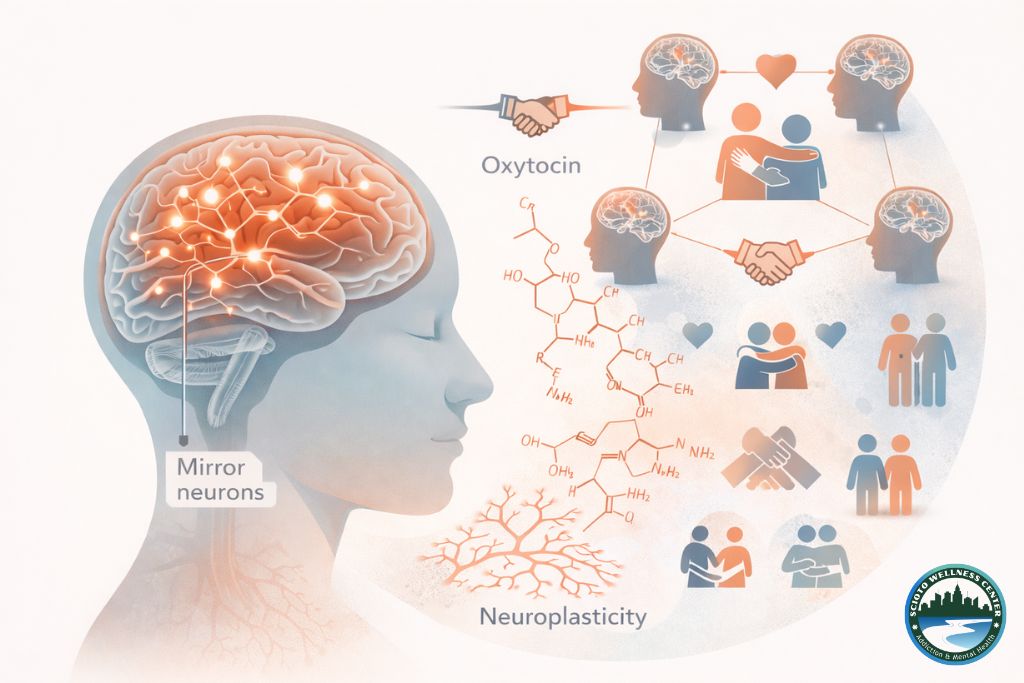
Your brain isn’t just wired for connection—it’s built for it. When you watch someone express emotion, specialized mirror neurons fire in your brain as if you’re experiencing that emotion yourself. In group therapy, when you witness someone process pain or practice coping skills, your brain activates the same neural pathways. You’re not just observing healing. Your brain is rehearsing it.
Social baseline theory reveals that humans evolved as deeply social beings. Our nervous system’s baseline assumes connection. When we’re isolated, our bodies interpret this as danger and activate stress responses. Research demonstrates that when people face challenges while connected to others, their physiological stress response decreases. The burden literally feels lighter when shared.
Then there’s oxytocin, the bonding hormone. Safe, supportive social connection triggers oxytocin release, which reduces anxiety and fear while increasing trust and openness. Group therapy at our intensive outpatient program creates a positive feedback loop: connection triggers oxytocin, which makes vulnerability safer, which deepens connection.
Finally, neuroplasticity means your brain constantly rewires based on experience. In a group, you observe multiple people modeling different coping strategies. Each observation creates new neural pathways. When you practice these skills in the safe social context of a group, you strengthen those pathways.
How Group Therapy Creates Change: Yalom’s 11 Therapeutic Factors
Psychiatrist Irvin Yalom identified eleven therapeutic factors explaining why group therapy works. These mechanisms operate simultaneously in every session, creating powerful healing unavailable in individual therapy alone.
Universality is discovering others share your struggles. Depression and anxiety thrive in isolation, whispering you’re uniquely broken. When you hear someone describe your exact experience, that moment shifts everything. The relief is immediate and profound.
Altruism means helping others helps you. Depression tells us we’re worthless. Then you offer support to another member and realize you’re still capable despite your struggles. Mike, in our intensive outpatient program in Columbus, was convinced he had nothing to offer. When a new member struggled with job loss—Mike’s trigger—he naturally offered practical advice. “Helping him reminded me I’m not helpless,” Mike said.
Instillation of Hope happens when you witness others at different recovery stages. You see someone six months ahead managing anxiety in ways that seem impossible now. That’s concrete evidence that change is possible.

Imparting Information combines psychoeducation from facilitators with wisdom from lived experience. You’re getting multiple perspectives on solving problems and practical strategies tested in real life.
Corrective Recapitulation of Primary Family means the group recreates family dynamics but healthier. Many struggles stem from family patterns. The group becomes a practice space to learn new ways of relating.
Development of Socializing Techniques happens as you learn and practice social skills in a safe environment. Understanding how anxiety shows up in social situations can help you recognize when a group provides real-time feedback on what works.
Imitative Behavior is learning through observation. You watch how others handle difficult emotions, set boundaries, or ask for help. These behaviors become possibilities in your repertoire.
Interpersonal Learning occurs because patterns from your outside relationships eventually show up in a group. You get real-time insight and feedback about dynamics usually invisible to you.
Group Cohesiveness is the sense of belonging and acceptance that develops over time. When you feel genuinely accepted despite your flaws, something fundamental shifts. You experience being known and still wanted.
Catharsis is safely releasing emotions you’ve been holding inside. When you express difficult feelings and the group doesn’t fall apart, you learn your emotions aren’t dangerous.
Existential Factors address universal human experiences—isolation, mortality, freedom, and meaning. Facing these big questions in a community makes them more manageable.
What to Expect in Group Therapy
You won’t just show up to strangers with no preparation. At Scioto Wellness, every person meets individually with a clinician first. This pre-group meeting assesses readiness, explains how the group works, answers questions, and normalizes the anxiety everyone feels.
Group rooms are designed for safety and comfort. Chairs are arranged in a circle with no barriers. Groups typically include 6 to 12 people with one or two trained facilitators. Sessions last 60 to 90 minutes and meet weekly.

Most sessions follow a predictable structure: an opening check-in where each person briefly shares what’s present, a working phase where members share deeply and process experiences, and a closing round where everyone shares a takeaway. This structure reduces anxiety about what will happen.
Your first session will likely feel awkward. You’ll probably listen more than talk. By sessions two or three, you’ll start participating more. Real vulnerability usually emerges around session seven and beyond after trust builds. Give it at least six sessions before deciding if it’s right for you.
Is Group Therapy Right for You?
Group therapy excels for depression (especially with isolation), anxiety disorders (particularly social anxiety), substance use disorders, relationship difficulties, grief and loss, life transitions, and trauma after stabilization. Our partial hospitalization program in Hilliard integrates daily group therapy as a core component.
Individual therapy may be better initially if you’re in active crisis, experiencing severe symptoms, recently traumatized and needing stabilization first, or actively suicidal. This doesn’t mean you can’t ever do groups. It means building stability first sets you up for group success.
Many find combining individual and group therapy most powerful. The individual provides deep personal exploration. The group offers practice and feedback in the community. At Scioto Wellness, we frequently recommend starting with both individual therapy and group or adding group after a few sessions establish baseline stability.
Addressing Your Concerns
“What if I’m judged?” Everyone is too focused on their own vulnerability to judge yours. Judgment is explicitly not allowed. Shared vulnerability creates empathy, not judgment.
“I’m too unique—no one will understand.” Emotions are universal even when situations differ. You don’t need identical experiences to relate. Often someone with a different problem offers the best insight.
“I’ll just sit there silently.” Listening is participating initially. No one is forced to share. Facilitators manage flow. Most people naturally start talking within a few sessions.
“Other people’s problems will make mine worse.” Facilitators manage content intensity. Witnessing others often provides perspective. Groups reduce overwhelm by sharing the burden.
Group Therapy Programs at Scioto Wellness Center
We offer multiple group types: mental health groups (depression/anxiety management, CBT skills, DBT skills, and process groups); addiction recovery groups (substance use disorder recovery, dual diagnosis, and relapse prevention); and specialized groups (young adults, men’s, and women’s).
Our structured programs integrate group therapy daily in PHP and three times weekly in IOP. We also offer weekly outpatient maintenance groups for ongoing support. Learn how to find your people in group therapy during intensive outpatient treatment.
Experience the Power of Group Therapy in Columbus
The hardest part is walking through the door the first time. That decision to show up despite fear, to trust that healing might happen in community rather than in isolation, takes profound courage.
If you’re ready to explore whether group therapy is right for you, support is available. Call Scioto Wellness Center at (888) 437-1898 or verify your insurance online. Our Hilliard team proudly serves Columbus, Grove City, Dublin, and all of Central Ohio.
Multiple group times are available. You can start any week. No pressure, just information and support as you decide what’s right for your healing journey.
You don’t have to heal alone. The science is clear. The transformation happens not despite the presence of others, but because of it.