
Let’s cut the noise: you’re sober, and it’s weird. Not because you’re doing something wrong—but because sometimes it feels like you’re doing it alone.
Maybe you quit drinking, or stopped using. Maybe it’s been a few weeks, or a few months. Maybe nobody knows how close you came to unraveling—or maybe everyone does. Either way, you’re white-knuckling through life that looks “fine” on the outside but still feels shaky underneath.
You’ve probably thought about therapy. Maybe you’ve done some already. But someone mentioned a Partial Hospitalization Program (PHP), and your gut reaction was:
“That sounds like overkill. I’m not that bad.”
Here’s the truth: PHP isn’t “too much.” It’s real help, in real time, for people who still have things to lose—and don’t want to lose them. If you’ve been sober for a minute but you’re still not okay, PHP might be the sweet spot between doing too little… and burning out.
1. PHP gives you structure—without removing you from life
You don’t have to vanish to get your life back on track. One of the biggest misconceptions about recovery support is that it means full-time, residential treatment.
PHP isn’t that.
It typically runs 5 days a week, for several hours each day—but you go home after. That means:
- You don’t lose your apartment or dorm room.
- You can still keep a part-time job or class, with the right planning.
- You get back in your own bed at night.
It’s intensive enough to matter, but flexible enough to not derail everything else.
That’s a huge deal, especially for young adults trying to keep momentum while still rebuilding.
2. You get real support when things get shaky (which they will)
Let’s be honest—early recovery is awkward.
Some days you feel amazing. Other days you want to burn your phone and ghost everyone. The cravings hit, or the loneliness, or the shame. Sometimes all three.
PHP means you’re not handling that on your own.
You’re surrounded by people—clinicians and peers—who expect the rollercoaster. You get:
- Daily therapeutic support
- Group processing with other people who get it
- Tools for what to do when you don’t want to do this anymore
The worst part of recovery isn’t cravings—it’s isolation. PHP keeps you connected when your brain wants to disappear.
3. You finally stop being “the only sober one”
Ever go to a party, bar, class, or group of friends and feel like the odd one out? Like everyone else can drink or smoke “normally” and you’re just the broken one?
Yeah. We get that.
In PHP, you don’t have to explain why you’re there. You’re not the weirdo for being sober—you’re one of many who’ve said, “Something had to change.”
And these people? They’re real. Some are barely hanging on. Some are a few steps ahead. But all of them are showing up—and that counts.
You get a community that’s not about perfection—it’s about progress.
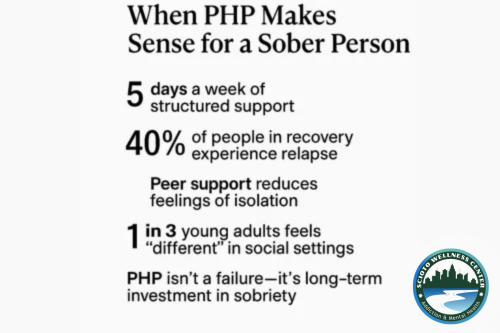
4. PHP doesn’t mean you failed—it means you want to win long-term
There’s this messed up idea in recovery culture that you either do it on your own or you’re “not strong enough.”
That’s garbage.
You don’t “earn” your recovery by how much you suffered. You don’t get extra points for doing it with no help.
You know what takes actual strength?
Saying: “I don’t want to go backwards. I want real support to keep going forward.”
PHP gives you that support:
- Without locking you in
- Without pulling you away from your life
- Without pretending everything’s fine when it’s not
You’re not broken for needing help. You’re human.
5. You don’t just stay sober—you get stronger
PHP is not just about staying clean. It’s about building a life you actually want to stay sober for.
That means:
- Learning how to sit with anxiety without numbing out
- Figuring out how to talk to your family again without blowing up
- Dealing with the social weirdness of being sober and young and surrounded by people who don’t get it
- Setting boundaries with friends who still use
- Making new habits that feel like healing—not just coping
You don’t get that from white-knuckling sobriety. You get it from support, structure, and a space to grow.
It’s not about how “bad” you are—it’s about how real you’re willing to be
If you’re reading this and thinking, “I’m not bad enough for PHP”—maybe that’s not the question.
Try asking:
“Am I okay enough without it?”
If the answer is no…
If you’re spinning in your own head…
If you’re waking up exhausted by the effort of staying on track…
You deserve more support. Not because you’re failing. But because you’re worth the care.
What does a PHP actually look like?
At Scioto Wellness Center, our Partial Hospitalization Program includes:
- Daily group therapy focused on recovery, mental health, relapse prevention, and emotional regulation
- Individual sessions with licensed clinicians
- Medication management if needed
- Skill-building using real-world scenarios
- Optional family involvement, if that’s part of your world
It’s intense, but it’s not overwhelming. You’re not shoved into a label. You’re supported as a full human trying to rebuild.
FAQs About Partial Hospitalization Programs (PHP)
Do I have to quit everything to go?
Not necessarily. While PHP is a significant time commitment, it doesn’t mean you have to quit your life. Many people balance PHP with part-time work, online classes, or other responsibilities—with planning and clinician support.
What if I’ve already been to therapy—how is this different?
PHP is a deeper level of care than weekly therapy. It’s daily, structured, and designed to address immediate challenges with accountability, peer support, and more tools. If weekly therapy isn’t enough right now, PHP can help.
Will people judge me for doing a “higher level” of care?
You might fear that—but most people respect the hell out of it. Choosing structured care isn’t weakness. It’s choosing healing over pretending.
How long does PHP last?
It varies. Some people do 2–3 weeks. Others stay for 4–6 weeks. The program is tailored to your needs and adjusted along the way. It’s not one-size-fits-all.
What happens after PHP ends?
You’ll typically step down to IOP (Intensive Outpatient) or regular outpatient therapy. The goal is always to keep building—not drop you cold-turkey when the program ends.
Still not sure if it’s too much? That’s okay. Start the conversation.
Call (888) 351‑9849 or visit our Partial Hospitalization Program page to learn more about how PHP can support your recovery in a way that actually fits your life. Not because you’re failing—but because you’re worth saving while it still matters.