
Your child is spiraling. You’re watching it happen—sometimes slowly, sometimes in one terrifying drop. It could be panic attacks, rage, dissociation, depression that turns everything gray. Or maybe it’s substances, withdrawal, missing classes, dropping out of life.
You’ve tried talking, calming, checking in, locking things up, looking the other way, and finally, pleading.
Still, the house feels like it’s holding a live wire.
But you don’t want to hospitalize them. Not yet. That feels too extreme.
You just need something that works. Something steady, safe, structured.
Something that says, “I see how bad it’s gotten—and I believe it can get better.”
That’s where a Partial Hospitalization Program (PHP) can be the life raft you didn’t know existed.
When home feels like a minefield
You keep telling yourself: “We’ll get through this.”
But the emotional whiplash is relentless.
One day, your young adult is withdrawn and quiet.
The next, they’re sleeping until 2 p.m., missing therapy, saying they “just need space.”
Then there’s a calm moment… and then a blow-up you never saw coming.
You find yourself walking on eggshells—careful with tone, conversation, and timing. You’re afraid to push, but afraid not to.
It doesn’t feel like parenting anymore. It feels like crisis management.
When home is no longer therapeutic, you can’t be their only line of defense.
When you know they need more—but a hospital feels like too much
Emergency departments can be overwhelming. Psychiatric holds, locked units, rushed evaluations, scared kids in gowns—they’re necessary in acute risk, but they’re not built for healing.
Most parents we talk to don’t want to “send their kid away.”
They’re not asking for 30-day inpatient treatment.
They’re asking:
“Is there something in between?”
Yes.
A Partial Hospitalization Program in Hilliard, Ohio is exactly that: a structured, full-time clinical program that offers mental health stabilization—without hospitalization.
What PHP actually looks like (and why it works)
Daily support without nightly separation
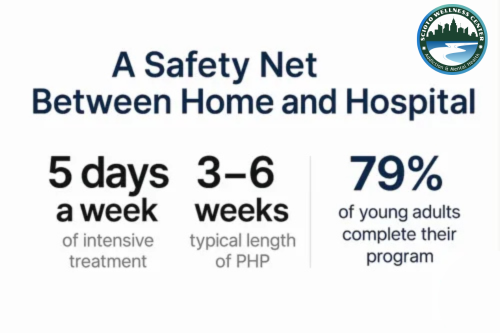
Most PHPs run Monday through Friday, for several hours each day. Your young adult returns home in the evenings—or stays in a recovery-friendly living environment.
It provides the daily structure of inpatient care—but allows for connection, routine, and gradual reintegration into life.
At Scioto, our PHP includes:
- Group and individual therapy
- Crisis management
- DBT and CBT skill-building
- Medication management
- Family involvement, when appropriate
It’s care for the whole person—not just a crisis response.
Why young adults actually do well in PHP
Because it treats them like people—not diagnoses.
They’re
- They’re challenged to participate, not punished for struggling.
- They build structure with support—not by force.
- They get time to reflect, regulate, and recover—without the overwhelm of inpatient or the loneliness of doing it alone.
We’ve seen clients who were on the verge of expulsion, overdose, or self-harm rediscover a sense of self and stability within three weeks.
No, it doesn’t fix everything. But it interrupts the spiral—and that changes lives.
What it offers you, as a parent in crisis
PHP gives your family space to breathe.
You’re not wondering every second if they’re okay.
You’re not the sole lifeline anymore.
You get to sleep at night.
You get to be a parent again—not a 24/7 crisis unit.
You’ll receive updates, support, and communication. And when it’s time, you’ll be part of the next steps.
Because your healing matters, too.
What happens when you call
Here’s how it usually goes:
- You reach out—by phone, form, or referral.
- We schedule an assessment—sometimes same day.
- We build a treatment plan based on clinical needs, history, and goals.
- Your young adult enters the program and begins daily care.
- We stay in touch, offering family support, updates, and planning.
You don’t need to know everything. You just need to say:
“Something isn’t working. Can we talk?”
From there, we guide you.
It’s okay if they’re not “on board” yet
You may be thinking, “They won’t agree to this.”
That’s common.
Most young adults in crisis aren’t asking for help. Many are burned out, scared, or defiant. That doesn’t mean they’re unreachable.
Sometimes, just offering an evaluation is the first crack in the wall.
They meet someone who listens.
They realize they don’t have to pretend.
And slowly, the willingness grows.
PHP isn’t about compliance. It’s about capacity. And many young people find theirs after they enter the room.
PHP isn’t giving up—it’s doubling down on hope
Parenting through crisis can feel like failing, even when you’re doing everything you can.
But here’s the truth: Getting help doesn’t mean you’re out of options. It means you’re choosing the right one.
You don’t have to wait for an overdose, a police call, or a psychiatric hold. You can act before the next break.
You’re not alone. And neither is your child.
FAQs: Partial Hospitalization Programs for Young Adults
What if my child refuses to go?
Start with a conversation, not a demand. Offer an evaluation—not a commitment. Clinicians are trained to engage reluctant young adults. Resistance is normal, and not a deal-breaker.
Is PHP residential? Will they be gone all day?
PHP is outpatient. Your child attends for several structured hours a day (usually 4–6), then returns home or to sober housing in the evening.
How is PHP different from inpatient or IOP?
Inpatient is 24/7 medical supervision. IOP is fewer hours, usually in the evening. PHP sits between them: daily care without overnight stay, ideal for stabilizing crisis.
What conditions qualify someone for PHP?
PHP supports a range of concerns—depression, anxiety, suicidal ideation, substance use, self-harm, trauma, school refusal, or behavioral changes in young adults. A clinical assessment will guide fit.
Will I still be involved as a parent?
Yes. Family therapy, education, and care coordination are integrated when appropriate. You’ll never be in the dark about your child’s progress.
How long does a PHP last?
It varies. Many young adults stay for 3–6 weeks, depending on clinical need. After PHP, clients often step down to IOP or outpatient therapy.
What happens after PHP ends?
We build a full discharge plan—including referrals, therapist matchups, school or vocational support, medication follow-up, and relapse prevention (if applicable).
You don’t have to wait for rock bottom. You can act now.
Call (888) 351‑9849 or visit our Partial Hospitalization Program page to talk with a clinician who understands crisis—and how to build safety on the other side of it.
Because “too soon” is always better than too late.