
There’s a moment in long-term recovery when the chaos is gone—but so is the spark.
You’re still showing up. Still doing the things. But some days, it feels like your life is more about maintenance than meaning. The highs are gone—but not because you’re using. They’re just… missing.
If you’ve hit that emotional flatline, it doesn’t mean you’ve failed. It means you’re human. And it might mean it’s time to reconnect—not with a version of you from the past, but with the version you became through the work you’ve already done.
That’s where our partial hospitalization program in Hilliard, Ohio comes in.
Sobriety Isn’t the End Goal. It’s the Starting Line.
Let’s be real: treatment talks a lot about getting sober. About surviving. About climbing out of the wreckage.
But what happens after the wreckage clears?
You rebuild. You stabilize. You get your job back. You move into a better place. Your relationships start to repair themselves. From the outside, things look good—maybe even impressive.
But inside, something feels… off.
You might not be in crisis, but you’re not really living either. And no one’s really talking about that part of recovery.
You don’t need to be falling apart to benefit from coming back to care. Sometimes, the most powerful healing happens when you let yourself pause—not because everything is burning down, but because you can feel yourself fading out.
When You Feel Disconnected, PHP Can Reconnect You
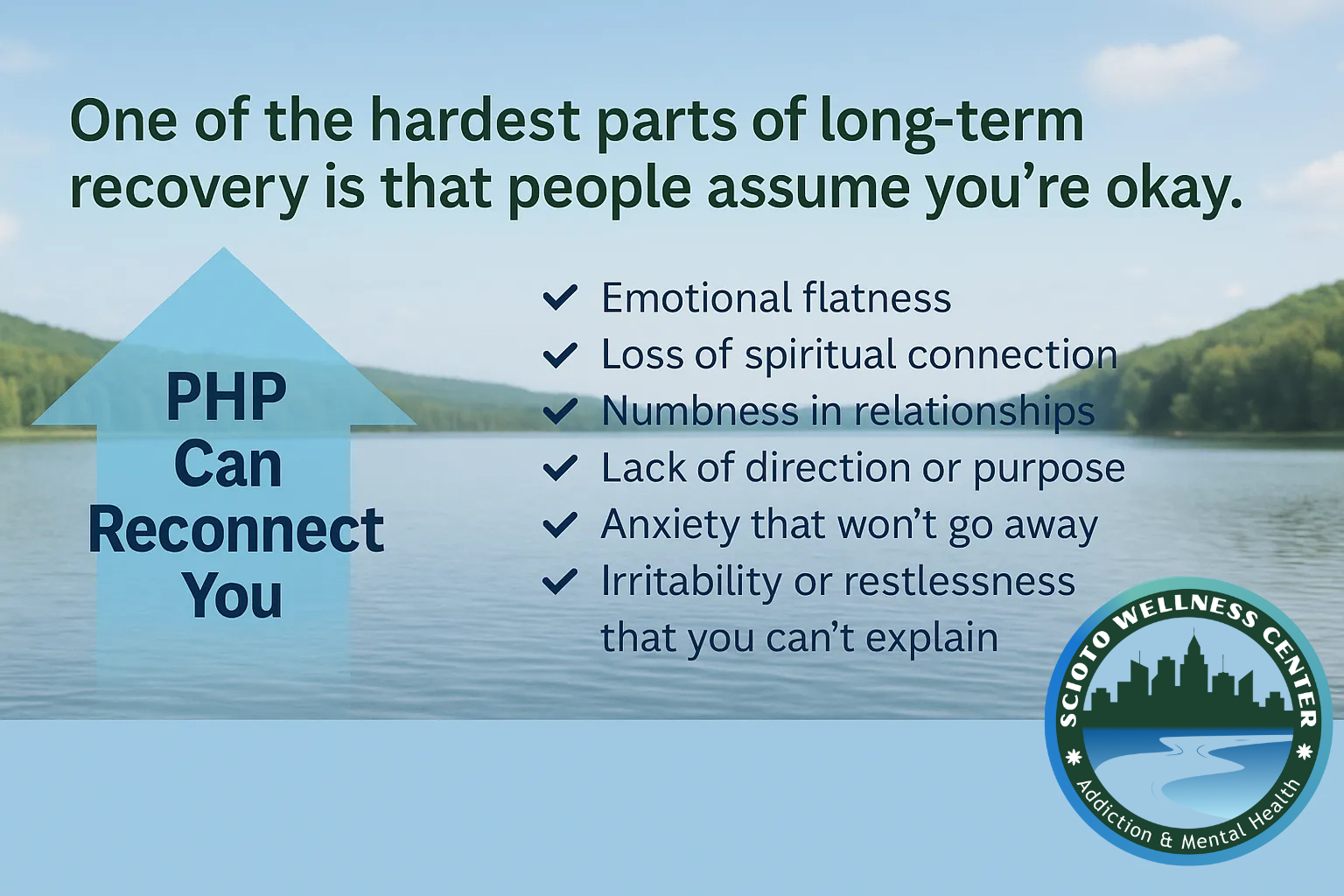
One of the hardest parts of long-term recovery is that people assume you’re okay.
You’ve got time. You’re not in active use. Maybe you’re even mentoring others. So it feels risky—or even shameful—to admit that you’re struggling with things like:
- Emotional flatness
- Loss of spiritual connection
- Numbness in relationships
- Lack of direction or purpose
- Anxiety that won’t go away
- Irritability or restlessness that you can’t explain
You might wonder: Is this just what life is now? The answer is no. But you do have to interrupt the drift.
A structured, therapeutic space like PHP can help you realign. Not because you’re broken—but because you’ve grown, and it’s time for your support to grow with you.
Returning Doesn’t Mean You’re Back at Square One
This needs to be said loud: Coming back to treatment doesn’t mean you’re failing.
At Scioto, we work with long-term alumni who return to our partial hospitalization program to re-anchor, reflect, and re-energize their recovery. It’s not about hitting reset—it’s about going deeper.
Here’s what makes PHP a smart choice if you’re feeling stuck:
- You’re surrounded by support, not just accountability
- You get dedicated time to work through emotional or mental health challenges
- You’re not juggling life and recovery at the same time—you get to focus on you
- You reconnect with structure, which often slips quietly in long-term recovery
- You remember what feeling fully alive actually felt like
This isn’t a rewind. It’s a reinvestment.
You Don’t Have to Fake It Here
The hardest part of being a long-term alum who’s emotionally stuck? Feeling like you can’t say it out loud.
You might be the strong one. The example. The one who made it.
But inside, maybe you’re thinking things like:
“I feel like I’m just coasting.”
“I miss the clarity I had early in recovery.”
“I don’t feel connected to myself anymore.”
“Everything feels muted.”
Those are real experiences. Not red flags. Not weaknesses.
In our partial hospitalization program, we create space for those truths. You don’t have to package your emotions, pretend to be inspired, or perform strength. You get to show up as you are—and we’ll meet you there.
PHP for Long-Term Alumni: What It Actually Looks Like
Coming back to care as a long-term alum doesn’t mean you’re signing up for the same treatment experience you had at the beginning. Our PHP is tailored, flexible, and built to meet you where you are now.
Here’s what it can include:
- Clinical therapy that centers your current emotional landscape—not just early sobriety challenges
- Group therapy with other adults navigating real-life transitions, not just initial detox and stabilization
- Life skills, emotion regulation, and processing groups that deepen resilience, not just reinforce basics
- Optional medication support if mental health symptoms have shifted or worsened
- Spiritual and values work to help you reconnect with your “why”
We also support dual-diagnosis care for alumni experiencing co-occurring mental health concerns like depression, anxiety, or trauma responses—especially if those symptoms have intensified in long-term recovery.
You’re not who you were when you started. And your care shouldn’t look the same either.
This Isn’t Burnout. It’s Something Deeper.
You’re not just tired. You’re soul-tired.
That kind of exhaustion doesn’t come from lack of sleep. It comes from living in emotional autopilot for too long. From ignoring the part of you that’s asking: Is this all there is?
The truth is, recovery isn’t just about what you walked away from. It’s about what you’re building now. And if it feels like you lost the thread—PHP can help you find it again.
“I didn’t relapse. But I did forget why I got sober in the first place. Coming back to Scioto helped me remember.”
– Alumni, 2023
What If You’re Not Sure It’s “Bad Enough”?
Let’s flip the question: What if it doesn’t need to get worse before you’re allowed to ask for more?
You don’t need to justify your pain. You don’t need to crash in order to course-correct. If something feels off—you’re allowed to explore that. You’re allowed to want more than just surviving.
Returning to PHP is like choosing to check your compass—not because you’re lost, but because you care about where you’re headed.
Recovery Isn’t a One-Time Event—It’s a Lifelong Conversation
And sometimes, you need to rejoin the conversation in a deeper way.
At Scioto, we believe that ongoing care isn’t a weakness—it’s wisdom. Just like you go to the gym to maintain strength, you come back to clinical support to maintain emotional clarity, purpose, and peace.
You don’t have to do it alone. And you don’t have to fake being “fine.”
FAQs: Returning to PHP in Long-Term Recovery
Do I have to relapse to come back to PHP?
No. Many alumni return to our partial hospitalization program without relapsing. Emotional disconnection, burnout, and mental health struggles are valid reasons to seek support—even without substance use.
Will I be in groups with people who just got sober?
Our PHP is designed to meet people at different stages. We take care in group placement to ensure you’re supported by peers with shared experience, not isolated in a room full of people with day-one energy.
Can I still work while in PHP?
PHP is typically a daytime, weekday commitment—about 5–6 hours a day, 5 days a week. If that’s not workable, our clinical team can discuss alternative options like intensive outpatient programming (IOP) that offers more flexibility.
What if I’m embarrassed to come back?
You’re not the first, and you won’t be the last. We hold zero judgment for alumni returning to care. If anything, we see it as a strength. It means you’re paying attention to your inner world—and that matters.
How do I know if PHP is the right level of care?
If you’re feeling emotionally flat, disconnected, or unmotivated—but don’t need 24/7 inpatient care—PHP is often a great fit. We’ll help you assess whether it’s the best next step.
You Remember the Beginning. Now Choose What Comes Next.
If you’ve been drifting through recovery—emotionally tired, spiritually muted, unsure of what’s missing—you’re not alone. And you’re not out of options.
At Scioto Wellness Center, our partial hospitalization program in Hilliard, Ohio is a space to come back to yourself. Not because you messed up. But because you matter.
Call (888) 351-9849 to learn more about our partial hospitalization program services in Hilliard, Ohio.