

When You’ve Walked Out Before
You started IOP once—and then stopped. Maybe you left mid-group, maybe you slowly ghosted, maybe you just didn’t come back after a rough week. Whether it was burnout, anxiety, a bad group vibe, or life outside treatment pulling at you—something made it too much. And now you’re here, rethinking things. Considering trying again. Wondering if it’s even worth it. Wondering if anyone wants you back.
Let’s say this upfront: you’re not the only one.
Dropping out of treatment happens. Ghosting happens. Feeling unsure happens. It doesn’t make you weak. It doesn’t mean you “wasted your shot.” It means something didn’t fit—and now you’re ready to adjust instead of abandon.
At Scioto Wellness Center, our Intensive Outpatient Treatment program in Hilliard, Ohio, isn’t about checking boxes or proving worth. It’s about giving real people space to get honest, get support, and get unstuck—even if they’ve fallen off before.
Here’s how to make this round of IOP feel different from the last.
1. Own Your Exit Without Overexplaining
You don’t need a three-page essay on why you stopped coming. Whatever pulled you away—emotional overload, work stress, a slip, feeling unseen—was valid. It happened.
Coming back doesn’t require an apology tour. You don’t have to walk into your first session with your head down or your defenses up.
A simple, “I wasn’t ready then, but I’m willing now” is enough.
What matters isn’t the exit. It’s the return.
2. Redefine What “Success” Looks Like in IOP
If you left last time feeling like you “failed,” it might be because your definition of success was impossible.
Success in intensive outpatient treatment isn’t perfect attendance. It’s not always feeling motivated. It’s not sharing in every group or loving every therapist.
Real success? It’s showing up even when you feel like hiding. It’s naming the resistance instead of pretending you’re fine. It’s being willing to try again.
This time, let success be measured in honesty, not in performance.
3. Tell the Truth About What Didn’t Work Last Time
One of the best things you can do on your first day back? Tell your therapist what didn’t work before.
Did the group dynamics feel off? Did the schedule mess with your life? Did you feel like you were faking it the whole time?
Say that.
Not only does it help your team adjust your treatment plan—it also breaks the cycle of silently struggling. Your therapist can’t fix what they don’t know. You deserve a plan that fits who you are now, not who you were six months ago.
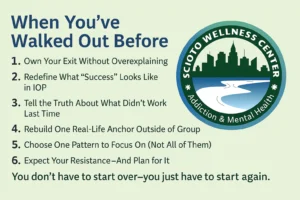
4. Rebuild One Real-Life Anchor Outside of Group
IOP can feel like a world of its own. Three or more sessions a week, constant reflection, deep emotional work—it’s a lot. If you don’t have anything outside of group that feels stabilizing, it’s easy to start feeling like you’re just surviving therapy instead of living life.
This round, build one thing that grounds you outside of sessions:
- A low-pressure morning walk
- A check-in text with someone who gets it
- A “no matter what” journal ritual
- A playlist that helps you regulate
You don’t need a full routine. Just an anchor. Something that says, “This version of me exists beyond therapy rooms.”
5. Choose One Pattern to Focus On (Not All of Them)
If your brain is already saying, “This time, I’m fixing everything,”—slow down.
One of the biggest reasons people flame out of treatment is trying to untangle every thread at once. All the trauma. All the behavior patterns. All the relationships. All the guilt.
Let’s not do that.
This round, pick one. Just one pattern that keeps tripping you up. Maybe it’s ghosting when things get hard. Maybe it’s numbing every emotion. Maybe it’s people-pleasing yourself into resentment.
Choose one. Focus on that. The others will start shifting naturally when you stop overwhelming yourself.
6. Expect Your Resistance—And Plan for It
You will hit a wall. You’ll get irritated. You’ll want to skip. You’ll start telling yourself therapy isn’t helping, or that everyone else in group is more “serious” than you. That voice is not failure—it’s resistance. And resistance is part of the process.
This time, expect it.
Say it out loud. “I know I’m going to want to bounce around week three.”
Create a check-in ritual on those days.
Ask your therapist to help you plan for that drop-off point.
Expect the mess. Prepare for it. That’s not failure. That’s strategy.
7. Let It Be Messy—and Keep Coming Anyway
There will be awkward sessions. Boring sessions. Sessions where someone shares something heavy and it stirs up your own stuff. You might not always like your group members. You might want to shut down. You might actually shut down.
All of that is normal.
The difference this round isn’t that you’ll avoid the mess. It’s that you’ll move through it differently. You’ll keep showing up. You’ll name what’s real. You’ll allow your healing to look like what it actually is: bumpy, nonlinear, beautifully imperfect.
You Don’t Have to Start Over—You Just Have to Start Again
If you’re coming back to IOP after leaving early, you’re not starting from zero. You’re starting from experience. You know what felt hard. You know what didn’t land. You know what you need more of.
That’s not backsliding. That’s information.
At Scioto Wellness Center, our Intensive Outpatient Treatment in Hilliard, Ohio is built for real life—not idealized recovery stories. We know some people ghost. Some people relapse. Some people need a few rounds to get traction.
You’re allowed to be one of them. And you’re still worth showing up for.
FAQs: Coming Back After Leaving IOP
I ghosted the last program. Will I be judged?
Not here. Ghosting is common. We care more about what you need now than what happened last time. Coming back is already a brave step. You’ll be met with respect, not shame.
Do I have to go back into the same group I left?
Not necessarily. If you want a fresh start with a different group or schedule, let us know. We’ll do our best to place you somewhere that feels supportive.
What if I left because I didn’t connect with the therapist?
That’s important feedback. Let us know. You have the right to a therapist who fits—someone you can actually talk to. We’ll work with you to find that match.
Will I have to explain why I dropped out?
Only if you want to. Some people process it out loud. Others don’t. Either way, your therapist can help you re-enter at your pace and on your terms.
What if I relapse again during IOP?
Relapse is not a deal-breaker. It’s data. If it happens, we’ll talk about what triggered it, what supports are missing, and how to move forward. You won’t be punished—you’ll be supported.
Thinking about coming back to IOP? You’re not too late. You’re right on time.
Call (888) 351-9849 or visit Scioto Wellness Center’s Intensive Outpatient Treatment page to learn more. Whether you’re re-entering after one week, one month, or one year—we’re ready when you are.