
You didn’t mean to fall off.
Maybe you missed a session or two. Maybe something happened—work, family, stress, relapse. Maybe it was nothing dramatic at all, just a slow fade. One day turned into a week. Then it started to feel like too much time had passed.
Now, just thinking about going back makes your chest tight.
Here’s what we want you to know: You’re not the only one. And you’re not disqualified. At our Intensive Outpatient Program in Hilliard, Ohio, we hold the door open—no matter how long you’ve been away.
This blog is for you. It’s a gentle guide for how to come back—not with shame, but with permission to begin again.
Step 1: Know That You’re Not the Only One Who Ghosted
Missing treatment is more common than most people think.
It doesn’t mean you failed. It doesn’t mean you weren’t serious. It just means you hit a bump—and for people in recovery, even small bumps can feel like cliffs.
Life happens. Schedules shift. Emotional energy runs out. And sometimes, the shame of missing a few days becomes the reason you stay away for weeks.
But let’s be clear: You’re not a dropout. You’re someone who took a pause. That pause doesn’t erase your progress. It doesn’t close the door. It’s just a part of your story—and it’s still being written.
Step 2: Make Contact—Even If It’s Just One Line
The hardest step is often the smallest one: reaching out.
You don’t need a full explanation. You don’t have to prove you’re serious. One simple line is enough:
“Hey, I’d like to come back. Can we talk?”
At Scioto Wellness Center, we’re prepared for that message. We don’t ask, “Why did you leave?” We ask, “How can we support you now?”
We’ve seen people come back after a week. After six months. After relapse, divorce, depression, or nothing in particular. What matters is that they came back—and that’s always worth celebrating.
Step 3: Expect Support, Not Punishment
A lot of people assume returning to IOP means judgment. That they’ll be quizzed, shamed, or made to start all over.
That’s not how it works here.
We know that dropout isn’t defiance—it’s usually pain, overwhelm, or burnout. So instead of gatekeeping your return, we offer gentle re-entry. That means:
- No shaming conversations
- No starting over unless clinically appropriate
- No “you have to explain yourself” pressure
Just a conversation about how to make your return feel manageable and supportive.
Step 4: Rebuild Slowly—Not All at Once
It’s okay to come back gently.
You don’t have to dive into full-time sessions right away. Maybe you start with one group a week. Or an individual session to process whatever’s been going on.
Returning to your intensive outpatient program isn’t about proving something—it’s about feeling supported enough to re-engage. That takes time, trust, and room to breathe.
We’ll help you find the right rhythm.
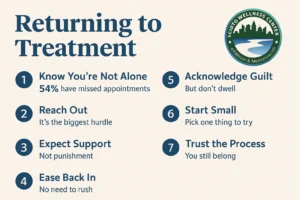
Step 5: Acknowledge Guilt—But Don’t Let It Drive the Car
Almost every returning client brings guilt with them.
They say:
- “I ghosted my group. I feel embarrassed.”
- “I drank again. I blew it.”
- “I should’ve reached out sooner.”
Guilt is normal. But it’s not the truth. The truth is that coming back is harder than starting—and you’re doing that. That takes courage, not apology.
We’d rather see you return with guilt than stay gone with shame.
Step 6: Pick Up a Thread You Dropped
You don’t need to recreate the whole treatment plan overnight. Just look for one small thing that once helped—and pick it back up.
It could be:
- A coping skill you liked
- A group topic that made you feel seen
- A therapist you trusted
- A note from a session that still lingers
You’re not starting from scratch. You’re starting from experience. That’s different—and that’s powerful.
Step 7: Let Yourself Be New Here—Even If You’ve Been Here Before
You might worry about what your peers or therapist will think.
“Do they think I gave up?”
“Will I be welcomed?”
“Do I even belong anymore?”
The answer is: yes, you do.
Your story didn’t end when you stopped showing up. It just got more real. And the most meaningful breakthroughs often come after the hardest returns.
We don’t expect you to be the same. In fact, we expect that you’re not. That’s why we hold space for the version of you who walked back in—whether cautiously, shakily, or with quiet resolve.
Scioto Wellness Center: We Keep the Light On
If you’re near Hilliard and wondering if it’s too late to return to treatment, here’s your answer: it’s not. Not even close.
We’ve supported countless people who needed to step away—then needed help stepping back in. Whether your time away included a relapse, a breakdown, or just a season of numbness, you’re still welcome.
Check out our Intensive Outpatient Program in Hilliard, Ohio. We offer flexible scheduling, compassionate clinicians, and a no-pressure return process.
What Returning Clients Say
“I thought I ruined my chance. I didn’t. They welcomed me like I never left.”
— Former IOP client, returned after 6 weeks
“Coming back was awkward for five minutes. Then I remembered: no one here wants me to feel bad—they just want me to heal.”
— Returned after ghosting mid-program
“I didn’t know how to say I needed help again. But all it took was one message.”
— Returned after relapse
FAQs: Returning to Your IOP After Time Away
Is it common to stop attending and come back?
Yes. Very. Life throws curveballs. People leave treatment for all kinds of reasons—what matters most is that you return when you’re ready.
Will I have to explain why I left?
Only if you want to. We’ll ask what support you need now—not why you left. You’re never required to “justify” your break.
Do I have to restart the program from day one?
Usually not. We’ll meet with you for a brief re-assessment and help you resume or reshape your treatment plan based on your current needs.
What if I relapsed during my time away?
That’s okay. We’re here to support you, not judge you. Relapse is part of many people’s story. It doesn’t cancel your progress—it adds context to it.
Will the group treat me differently?
No. Group is a safe space, and many peers will have experienced similar pauses. The culture at Scioto is warm, welcoming, and nonjudgmental.
Can I adjust my schedule to make coming back easier?
Absolutely. We’ll work with you to find session times and a pace that fits where you are right now.
Want to reconnect? Let’s make it simple.
Call (888) 351-9849 or visit Scioto Wellness Center’s Intensive Outpatient Program to talk about rejoining treatment in Hilliard, Ohio. No shame. No lectures. Just support—right when you need it most.