
Let’s be honest: there are days when staying in treatment feels impossible.
You’ve been showing up, doing the work (some days more than others), sitting in groups, maybe even opening up a little. But now? You’re tired. Maybe bored. Maybe numb. Maybe triggered. Maybe just done.
And the thought crosses your mind:
“I could just stop going.”
If you’re in an Intensive Outpatient Program (IOP) and you feel like checking out, ghosting, or giving up—you’re not alone. And it doesn’t mean you’re failing. It means you’ve hit the middle.
This blog is for that moment.
The Middle Is Messy—but Normal
The beginning of treatment often comes with adrenaline. It’s a big step. New place. New people. You might feel hopeful, nervous, or even kind of proud you made it.
But by week 2 or 3, the emotional hangover sets in.
The stories in group hit too close to home.
You get tired of talking about “coping skills.”
You start wondering if anything is really changing.
That’s the middle—and it’s not a breakdown. It’s a turning point.
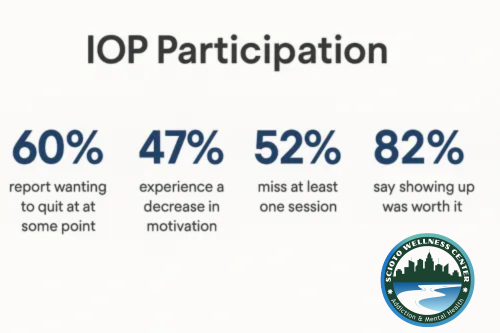
Progress in IOP doesn’t look like a straight line. It’s loops, backtracks, breakthroughs, shutdowns, then more loops. If you’re still showing up? That is progress—even if it doesn’t feel like it.
You Don’t Have to “Feel Like It” to Show Up
One of the biggest myths in recovery is that you have to be motivated every day.
Motivation comes and goes. It’s unreliable. What gets people through IOP is not motivation—it’s commitment.
Even if you sit in group without saying a word…
Even if you cry through the whole hour…
Even if you feel completely out of place…
You’re still in it. You’re still doing it.
Recovery is showing up on the days when you don’t want to. That’s where real growth happens.
Talk About the Part of You That Wants to Quit
You’re allowed to say, “I don’t want to be here today.”
You’re allowed to say, “I’m not feeling this.”
You’re allowed to say, “I’m thinking about quitting.”
Say it out loud—to your clinician, to the group, even just to yourself.
At Scioto Wellness Center, we don’t expect you to be happy about treatment every day. We expect you to be human.
When you talk about your resistance, we can help you understand it:
- Are you feeling overwhelmed?
- Are you scared of what’s coming up?
- Are you doubting whether you even deserve to get better?
All of those things are worth naming. When you bury your resistance, it grows. When you name it, it shifts.
Don’t Compare Your Progress to Everyone Else’s
This one sneaks in fast.
You hear someone in group say they’ve been sober for 30 days, and you just relapsed two nights ago.
You hear someone describe a big breakthrough, and you can’t even cry yet.
You start thinking:
“They’re doing it better than me.”
But group isn’t a race. It’s not about winning. It’s not about being the “best” at recovery. Everyone in IOP is carrying a different weight, on a different timeline.
Your job is not to catch up. Your job is to stay in your lane.
Healing isn’t performance—it’s practice. And everyone’s practice looks different.
You Can Come Back, Even If You Ghosted
Maybe you’ve already skipped a few sessions. Maybe you haven’t shown up in a week—or more. Maybe you left mid-group and never returned.
And now, you feel weird about going back. Ashamed. Embarrassed. Disconnected.
Here’s the truth: you can still come back.
There’s no perfect re-entry. You don’t have to explain everything. You don’t have to apologize. You can literally walk in and say, “I want to be here again,” and that’s enough.
We’ve seen this story hundreds of times:
- Ghosted for two weeks → came back → stayed for the full course
- Dropped out → came back after relapse → opened up more than ever
- Quit mid-program → re-enrolled → now mentoring others in group
There is no shame in returning.
There is only strength.
Make It One Step Smaller
If coming to a full session feels overwhelming, shrink the ask:
- “I’ll show up for 15 minutes.”
- “I’ll just sit and listen today.”
- “I’ll only go to group, not individual this week.”
Your clinician will meet you where you are.
Engagement isn’t all-or-nothing.
Some weeks are survival. Some are growth. Both count.
Reach for Your Supports (Even If You Haven’t Used Them Yet)
Your IOP isn’t just three groups and a therapist. It’s a network.
You might have access to:
- Family therapy
- Case management
- Medication support
- Peer support
- Crisis planning
If you haven’t used those yet—it’s not too late.
If you’re struggling to stay engaged, those supports might be the lifeline that keeps you tethered.
Even a 10-minute check-in with a case manager can shift the whole day.
Why IOP Is Worth Pushing Through
An Intensive Outpatient Program in Hilliard is one of the most flexible and supportive forms of treatment. It gives you structure without taking over your life.
Clients who complete IOP often say:
- “I finally understood myself.”
- “I learned how to sit with my emotions instead of running.”
- “Group helped me say things I never even told my therapist.”
- “I didn’t realize I wasn’t alone until I showed up enough times.”
You don’t need to love it every day. But if you can stay long enough to break through the middle—you’ll feel the shift.
FAQs: Staying Engaged in an Intensive Outpatient Program
What if I’m just too emotionally drained to keep going?
Tell your clinician. IOP can be intense, and emotional fatigue is common. You may need to modify your schedule or add support—not drop out.
Can I take a break and return to IOP later?
Some IOPs allow step-downs or brief pauses. It depends on your program and treatment plan. Talk to your team before making any decisions alone.
What if I relapsed during IOP?
You’re not kicked out. Relapse is part of many recovery journeys. Being honest about it gives your team the chance to support you through it.
I feel like I’m not getting anything out of group. Should I leave?
Bring that feeling into the room. A lot of resistance comes right before a breakthrough. Sharing your disconnection can actually deepen the work.
What if I don’t feel comfortable in my current group?
You can ask about switching groups or changing formats. If the fit doesn’t feel right, your comfort matters—and we want to get it right with you.
Still thinking about quitting? Take this step first.
Call (888) 351-9849 or visit our Intensive Outpatient Program page to talk with someone who gets it. Whether you’ve been ghosting, struggling, or just can’t find your footing, we’re here—and there’s still time to stay in the room.